N° 15 enero – junio 2025. E-ISSN: 2709 – 3689
Systematic Review
Dossier: Política y Gestión Ambiental
AI-Enhanced Language Design - ChatGPT: Bibliometric Analysis and Potential Uses in the Conservation and Restoration of Tropical Ecosystems
Diseño de lenguaje mejorado con IA - ChatGPT: análisis bibliométrico y usos potenciales en la conservación y restauración de ecosistemas tropicales
Smith E. Reyes Palomino
Universidad Tecnológica del Perú
| How to cite: Reyes Palomino, S. (2025). AI-Enhanced Language Design - ChatGPT: Bibliometric Analysis and Potential Uses in the Conservation and Restoration of Tropical Ecosystems. Revista Kawsaypacha: Sociedad Y Medio Ambiente, (15), D-007. https://doi.org/10.18800/kawsaypacha.202501.D007 |  |
Abstract: ChatGPT, in line with other established artificial intelligence systems, emerges as an advanced tool based on OpenAI's GPT model. This study focuses on exploring its applicability in the conservation and restoration of tropical ecosystems. A bibliometric analysis dissects the main characteristics, learning systems, and potential applications of ChatGPT. Questioned about its groundbreaking potential in the conservation and restoration of tropical ecosystems, ChatGPT outlines applications in assessment and planning, education, monitoring and rapid response, interaction with field tools, and policy support. Although ChatGPT does not inherently provide scientific support, subsequent analysis confirms that its proposals align with current trends in conservation and restoration. When using tools like ChatGPT in scientific contexts, researchers should adopt a critical approach, verifying the provided responses. Additionally, we underscore the need for further research on the ethics of implementing artificial intelligence in conservation and restoration domains.
Keywords: ChatGPT. Ecological Restoration. Ecological Conservation. Tropical Ecosystems. Bibliometrics. Technological Interaction.
Resumen: ChatGPT, en línea con otros sistemas de inteligencia artificial consolidados, surge como una herramienta avanzada basada en el modelo GPT de OpenAI. Este estudio se centra en explorar su aplicabilidad en la conservación y restauración de ecosistemas tropicales. Un análisis bibliométrico examina las principales características, sistemas de aprendizaje y aplicaciones potenciales de ChatGPT. Ante la pregunta sobre su potencial innovador en la conservación y restauración de ecosistemas tropicales, ChatGPT propone aplicaciones en evaluación y planificación, educación, monitoreo y respuesta rápida, interacción con herramientas de campo y apoyo a políticas. Aunque ChatGPT no proporciona respaldo científico de manera inherente, un análisis posterior confirma que sus propuestas se alinean con las tendencias actuales en conservación y restauración. Al utilizar herramientas como ChatGPT en contextos científicos, los investigadores deben adoptar un enfoque crítico, verificando las respuestas proporcionadas. Además, se resalta la necesidad de profundizar en la investigación sobre la ética de la implementación de la inteligencia artificial en los ámbitos de la conservación y la restauración.
Palabras clave: ChatGPT. Restauración ecológica. Conservación ecológica. Ecosistemas tropicales. Bibliometría. Interacción tecnológica.
1. Introduction
«Artificial intelligence» (AI) denotes the ability of computer systems to emulate human cognitive functions such as learning and reasoning, qualities that are inherently human (Sadiku et al., 2021). While AI emerges as an invaluable resource that enriches and facilitates life in various spheres, its limitations must be acknowledged, as well as the importance of human interaction and appropriate guidance within the educational process (Dimitriadou & Lanitis, 2023).
In today's digital horizon, innovative AI-powered systems such as Siri, Alexa, Google Assistant, and notably, ChatGPT, have emerged. Each of these systems boasts its own merits and challenges; however, ChatGPT, in particular, symbolizes a transition from traditional AI to a more contextual and responsive AI (Stokel-Walker & Van Noorden, 2023). Operating under OpenAI's GPT (Generative Pre-trained Transformer) model, ChatGPT generates text by scouring vast amounts of training data, understanding the correlation between words and phrases. It stands out as a contextual AI model that tailors its responses by learning user preferences and behaviors, even offering advice on personal matters (Huh, 2023).
ChatGPT's potential spans multiple domains, with evident applications in education, journalism, scientific writing, and biotechnology (Holzinger et al., 2023). Moreover, there's an emerging discourse on the implications of generative AI in media education and journalism, as well as its ability to collaborate with humans in content creation (Pavlik, 2023). While ChatGPT has proven to be a useful tool, it has also sparked debates about authorship and authenticity in the academic and scientific realm (Else, 2023; Thorp, 2023). As pointed out by van Dis et al. (2023), the future of ChatGPT and similar AI technologies suggests a robust research agenda to understand and maximize their utility while mitigating potential risks and integrating them across various fields.
The aim of this paper is to analyze the different application possibilities of the ChatGPT language model in the research of the conservation and restoration of tropical areas.
2. Bibliometric analysis based on ChatGPT
The proliferation and rapid evolution of artificial intelligence over the past decade have sparked significant interest in the scientific and technological community. ChatGPT, a landmark in this AI landscape, has emerged as a go-to tool for conversations and natural language analysis. As its influence and application expand, it is essential to review the scientific literature to understand the scope, implications, and trends associated with
this tool.
For this purpose, a comprehensive review was conducted of the Scopus database on August 18, 2023, using «ChatGPT» as the focal keyword. The search focused on the title, abstract, and keywords of the documents, revealing a total of 27 papers addressing this topic from various perspectives. It is important to note that the vastness and depth of this literature required advanced analytical tools to distill relevant information and
emerging patterns.
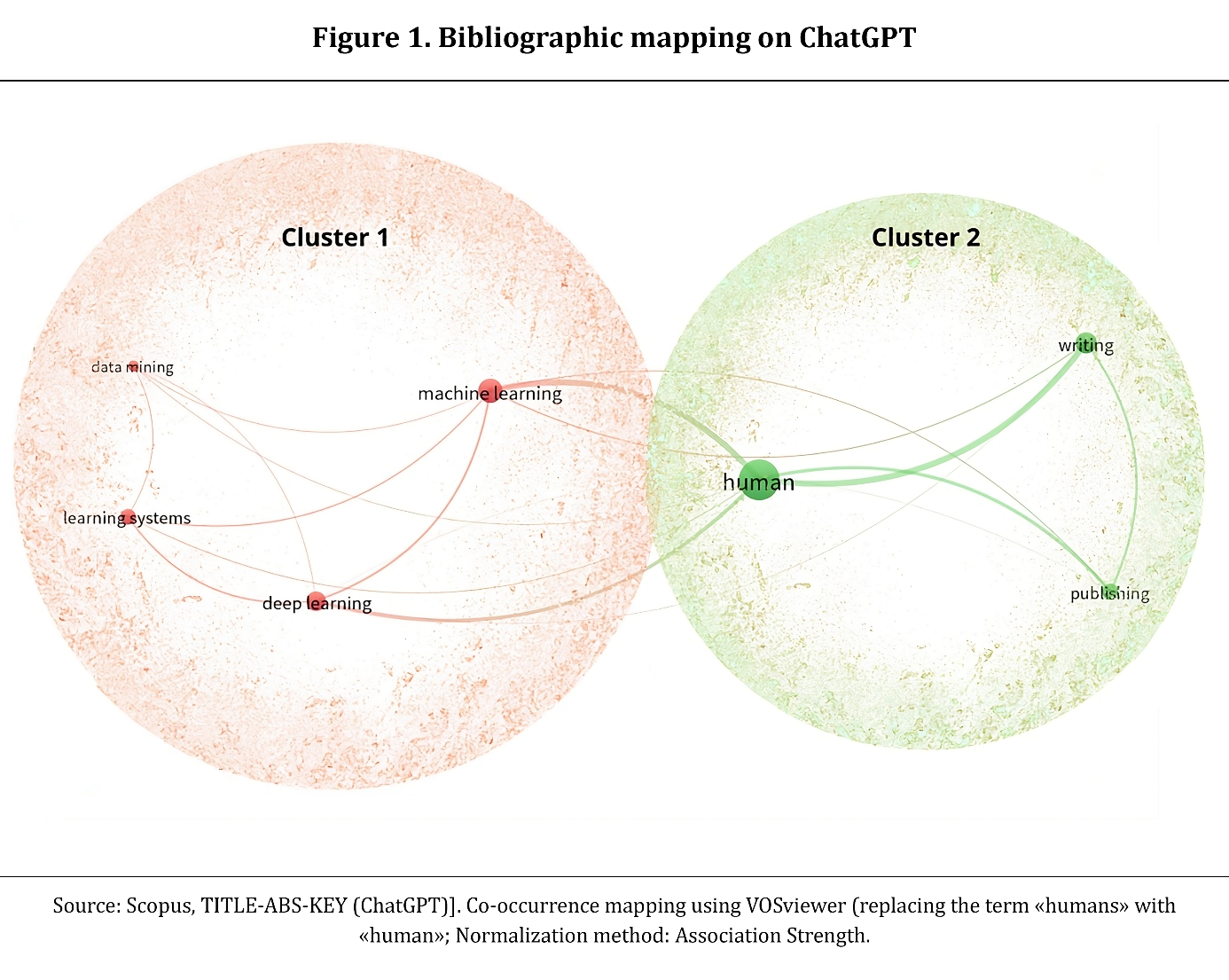
In this context, we used VosViewer, a software specialized in visualizing and analyzing bibliometric data. This tool allows us to create and interpret bibliometric maps, facilitating the identification of relationships and trends within large datasets. Using version 1.6.19, a Co-occurrence Map is generated to illustrate the connections between key terms related to ChatGPT. To achieve a more precise interpretation, linguistic adaptation is applied, replacing «humans» with «human» Moreover, the normalization method known as «Strong Association Strength» highlights the most significant relationships between terms, ensuring robust and reliable insights. This normalization method, available within VosViewer, is specifically designed to enhance the interpretability of co-occurrence networks by emphasizing the strongest associations between terms (van Eck & Waltman, 2010). VosViewer's ability to process and visualize complex bibliometric data makes it an indispensable tool.
This methodical and detailed approach provides a clear understanding of how ChatGPT is perceived and discussed in scientific literature. A detailed visualization of the emerging clusters is presented in Figure 1 below.
Cluster 1: The Deep Learning Paradigm and Computational Methodology in ChatGPT. The first cluster delves into the confluence of contemporary methodologies and underlying computational techniques in ChatGPT. At its epicenter, we find «machine learning», which serves as the cornerstone of ChatGPT's architecture. This mechanism is elevated by cutting-edge techniques, specifically «deep learning» (Buadze et al., 2023). Through artificial neural structures, ChatGPT emulates cognitive features, allowing it to process vast domains of information with unprecedented depth. The term «data mining» illustrates the rigor with which ChatGPT explores, analyzes, and distills intrinsic patterns from extensive datasets. This capability is indispensable to ensure precise and contextualized responses. Meyer et al. (2023) discuss how ChatGPT and large language models present both opportunities and challenges in the academic sphere, which can relate to data mining and learning systems within an academic context. «Learning systems» refer to the model's plasticity and adaptability, underscoring its capacity to evolve in response to new stimuli and paradigms. These capabilities are particularly evident starting from GPT-4, which is available in both paid and free versions. This iteration offers advanced adaptability and improves contextual understanding compared to its predecessors, making it especially useful in academic and research settings. In their study, Liu et al. (2023) describe ChatGPT as a significant milestone in the artificial intelligence field, with particular emphasis on its effectiveness in mathematical contexts. However, its susceptibility to conceptual errors is noted, especially in versions prior to GPT-4. This study uses GPT-4 or later versions, as these iterations demonstrate enhanced accuracy and reduced error rates, addressing many of the limitations highlighted in earlier research.
Cluster 2: Human-Machine Synergy in the Digital Age: A Focus on ChatGPT. The second cluster focuses on the dialectic between emerging technology and human interaction. The term «human» stands as a metaphor for the intersection between the user and the machine, emphasizing the importance of bidirectional communication. ChatGPT is not merely a reactive system; it is, in essence, a proactive model that learns, adapts, and refines its responses from continuous human interactions (Haleem et al., 2022). The descriptors «writing» and «publishing» hint at ChatGPT's reach into the academic and literary realm. We can infer that ChatGPT is posed as an auxiliary tool in writing and publishing processes, offering advanced solutions for researchers, authors, and academics. One publication notes that the use of AI tools like ChatGPT is becoming increasingly pivotal in scientific writing and suggests that instead of resisting this trend, a better approach would be to adapt and learn to use these tools effectively (Huang & Tan, 2023). Together, these clusters provide a holistic view of ChatGPT: a meticulously designed amalgamation of cutting-edge technology designed to collaborate and coexist with human intellect across various disciplines and applications.
3. Applications of ChatGPT in the conservation and restoration of tropical ecosystems
The scientific literature on the application of ChatGPT in the conservation and restoration of tropical ecosystems is limited. Nevertheless, its usefulness in environmental monitoring and conservation is documented, facilitating the tracking of ecological changes and the making of sustainable decisions (Zhu et al., 2023). In ecologically complex areas, accurate information is vital, and ChatGPT can quickly provide relevant data, supporting restoration and conservation projects.
To ensure the reliability and replicability of the responses generated by ChatGPT, multiple tests were conducted using specifically designed prompts. These tests examined whether ChatGPT's answers varied depending on the formulation of the question, the language used, or prior interactions. The responses included in this study were selected based on their consistency across these scenarios and their alignment with established scientific principles. It is important to note that ChatGPT's training data is updated periodically. While OpenAI regularly releases updates to its models, it does not always specify the exact dates or details of these updates, making it essential to verify the accuracy of the information provided, particularly in rapidly evolving fields. For this work, the analysis was conducted using the most recent data available, with a cutoff date of April 2023, as provided by OpenAI's GPT-4 model.
3.1 Potential Uses of ChatGPT in the Conservation of Tropical Ecosystems
To elucidate the potential of ChatGPT in the context of tropical ecosystem conservation, a specific inquiry (in English) was made to the language model: What are the main applications where ChatGPT would revolutionize the conservation of tropical ecosystems? Specific prompts were designed to ensure consistency in the responses and to explore the model's adaptability to different languages and question formats. These prompts were structured as follows:
General context: A prompt focused on providing a detailed explanation of ChatGPT's role in tropical ecosystem conservation, covering broad areas such as data analysis, education, monitoring, interaction with tools, and
policy development.
Specific applications: Additional prompts were designed for each area of application, including data analysis, educational initiatives, real-time monitoring, interaction with advanced tools, and policy support. These prompts requested concrete examples to illustrate ChatGPT’s potential in these domains.
Multilingual adaptability: To test ChatGPT's versatility, the prompts were translated into various languages, ensuring the model's responses remained consistent and relevant regardless of the language used.
The specific prompts utilized for this study were:
Provide a detailed explanation of how artificial intelligence, specifically ChatGPT, can contribute to the conservation of tropical ecosystems. Focus on areas such as data analysis, education, monitoring, interaction with tools, and policy development.
Explain how ChatGPT can support data analysis and management in tropical ecosystem conservation. Provide examples of how it can help identify at-risk areas or suggest solutions based on ecological patterns.
Describe how ChatGPT can be used as an educational tool to raise awareness about biodiversity and conservation in tropical ecosystems. Include examples of content customization and communication in multiple languages.
How can ChatGPT assist in real-time monitoring and rapid response for threats to tropical ecosystems? Provide examples of integration with tools like sensors
or drones.
Explain how ChatGPT can act as an interface for advanced tools like drones or automated systems in tropical conservation projects. Highlight its potential for real-time data analysis and user interaction.
Discuss how ChatGPT can assist policymakers in drafting and evaluating conservation policies for tropical ecosystems. Provide examples of synthesizing research and suggesting sustainable practices.
ChatGPT's response was:
ChatGPT has the potential to significantly innovate in the conservation of tropical ecosystems through several key areas. Some of the most notable applications include:
a. Data Analysis and Management: ChatGPT can process and analyze vast amounts of ecological information, providing crucial insights for conservation. From identifying at-risk areas to suggesting solutions based on scientific studies, conservationists can inquire about specific patterns or threats and receive detailed insights and intervention options based on existing data.
b. Education, Awareness, and Communication: ChatGPT can be a versatile educational tool, offering adapted and dynamic content about tropical conservation. Educators, students, and the public can inquire about biodiversity, its importance, and challenges in tropical ecosystems, and ChatGPT can provide detailed information and relevant educational resources. Moreover, it facilitates communication with local communities in various languages and dialects.
c. Monitoring and Rapid Response: Integrated with monitoring systems, ChatGPT can detect and alert about ecological changes or threats in real-time. Park rangers and conservationists can ask about specific situations in protected areas, and ChatGPT can provide swift responses based on recent data and suggest
intervention strategies.
d. Interface with Technology and Tools: ChatGPT can serve as a linguistic interface for advanced technological tools like drones or camera traps. Users can interact with these devices via ChatGPT, requesting data, images, or specific analysis of conservation areas and receive processed and contextualized information.
e. Development and Support in Policies: ChatGPT can assist in the drafting and assessment of conservation policies. Policymakers and stakeholders can inquire about the best practices, the impact of previous policies, and recommendations for future initiatives. ChatGPT can offer detailed analyses based on existing research and suggest effective approaches for the sustainable management of tropical ecosystems.
The implications of ChatGPT technology in various fields are undeniable, and its potential has been highlighted by Janzen (2023). The application of ChatGPT could be extended to tropical ecosystem conservation, utilizing its analytical capability to address challenges in this area. According to a study, by processing large amounts of data, ChatGPT can assist in preventing and reducing the impact of natural phenomena that lead to disasters, which is crucial in the management of ecosystems vulnerable to such events (Xue et al., 2023).
Let's now examine the scientific backing behind each application proposed by ChatGPT. This rationale is based on previous research employing artificial intelligence that corroborates ChatGPT's suggestions:
a. Data Analysis and Management: Supported by AI, ChatGPT can process and analyze vast ecological datasets, aiding in the identification of at-risk areas and proposing solutions rooted in scientific studies for the conservation of tropical ecosystems (Reyhani Haghighi et al., 2023; Ditria et al., 2022). An innovative tool developed aids in systematic conservation planning (Schoormann et al., 2023), while Machine Learning techniques enhance the connection between big data and ecological insights, as exemplified by the Wildlife Insights initiative which automatically processes millions of camera trap images for conservation studies (Tuia et al., 2022).
b. Education, Awareness, and Communication: ChatGPT can facilitate education and communication in tropical conservation by offering adapted content. Trends demonstrate the integration of AI in education, encompassing personalized learning and online learning processes (Bozkurt et al., 2021). Tuia et al. (2022), utilizing AI, promote conservation and global public engagement. Furthermore, AI can assist in biodiversity conservation planning, providing a framework to assess conservation strategies (Silvestro et al., 2022).
c. Monitoring and Rapid Response: Integrated with monitoring systems, ChatGPT can revolutionize conservation monitoring and management through automation, allowing real-time detections and alerts about ecological changes or threats in tropical regions (Ditria et al., 2022). AI systems deliver real-time data for swift responses to environmental threats and emergencies, intervening in various ways to protect ecosystems, like monitoring illegal deforestation (Kar et al., 2022; Szramowiat-Sala, 2023). Additionally, AI accelerates ecological surveys, providing invaluable information to park rangers and conservationists about specific situations in protected areas (Hoekendijk et al., 2021).
d. Interface with Technology and Tools: ChatGPT can enhance interaction with technologies like drones and camera traps in tropical conservation, enabling users to request and receive processed information from conservation areas (Tuia et al., 2022). A notable design integrates AI into camera traps, allowing real-time data transmission to users, with applications in biodiversity monitoring and the detection of illegal activities (Whytock et al., 2021). Such technologies, easing the human analysis burden, permit swift responses to threats in conservation areas (Leorna & Brinkman, 2022).
e. Development and Support in Policies: ChatGPT can aid in formulating and evaluating conservation policies, providing analyses grounded in existing research for the sustainable management of tropical ecosystems (Silvestro et al., 2022). It can synthesize vast amounts of data to assist policymakers in generating more impactful policies (Patel et al., 2021). Moreover, through integration with AI technologies, it can propose innovative solutions and expedite responses to conservation challenges (Swami, 2021).
3.2 Potential Uses of ChatGPT in Tropical Areas’ Restoration
To elucidate the potential of ChatGPT in tropical ecosystem restoration, a specific query was posed to the language model, namely «What are the main applications in which ChatGPT would revolutionize tropical area restoration?» Specific prompts were designed to ensure consistency in the responses and to explore the model's adaptability to different languages and question formats. These prompts were structured as follows:
General context: A prompt was designed to request a comprehensive explanation of ChatGPT's role in tropical ecosystem restoration, focusing on key areas such as assessment and planning, education, monitoring, interaction with tools, and
policy support.
Specific applications: Additional prompts were created to address each area of application in detail, including concrete examples to illustrate how ChatGPT could contribute to restoration efforts.
Multilingual adaptability: To ensure replicability, the prompts were translated into multiple languages, verifying that ChatGPT provided consistent and relevant responses across different linguistic contexts.
The specific prompts utilized for this study were:
Provide a detailed explanation of how artificial intelligence, specifically ChatGPT, can contribute to tropical ecosystem restoration. Focus on areas such as assessment, planning, monitoring, education, and policy support.
Explain how ChatGPT can assist in assessing and planning restoration strategies for tropical ecosystems. Include examples of species selection and intervention methods based on data analysis.
Describe how ChatGPT can serve as an educational tool in restoration projects, offering tailored content on techniques, principles, and challenges in tropical ecosystem restoration.
How can ChatGPT support monitoring and post-restoration follow-up? Provide examples of how it can provide real-time updates on the progress of
restoration activities.
Explain how ChatGPT can interact with advanced tools, such as drones or automated irrigation systems, to optimize tropical ecosystem restoration activities.
Discuss how ChatGPT can assist in identifying effective policies and funding opportunities for tropical ecosystem restoration. Provide examples of synthesizing research and suggesting sustainable practices.
ChatGPT's response was:
ChatGPT has the capability to significantly innovate in tropical ecosystem restoration in several key aspects. Some of the most notable applications include:
a. Assessment and Planning for Restoration: ChatGPT can analyze vast amounts of data on degraded areas and provide optimal strategies for restoration. From selecting suitable species for reforestation to effective intervention methods, restorers can inquire about the status and history of specific areas, and ChatGPT can offer a detailed plan based on evidence and prior studies.
b. Education and Training in Restoration: ChatGPT can serve as a vital educational tool, offering tailored content on ecological restoration techniques and principles. Students, technicians, and communities can learn about the best practices and challenges in tropical restoration, with ChatGPT providing specific answers and updated educational material.
c. Monitoring and Post-Restoration Follow-Up: By integrating with monitoring systems, ChatGPT can provide real-time updates on the progress and success of restoration activities. Specialists can ask questions about the health and development of restored areas, and ChatGPT can offer immediate feedback and suggestions for future interventions.
d. Interaction with Field Tools: ChatGPT can act as a linguistic interface for technological tools used in restoration, like automated irrigation systems or drones for seed dispersion. Technicians can interact with these devices via ChatGPT, requesting specific data or adjustments to maximize restoration activities' success.
e. Support in Restoration Policies and Financing: ChatGPT can assist in identifying effective policies and funding opportunities for restoration projects. Managers and decision-makers can gain insights into the feasibility, costs, and benefits of specific projects, with ChatGPT providing detailed analysis and connecting users with relevant studies and potential funding sources.
Let's now examine the scientific support for each application proposed by ChatGPT. This justification is based on prior research that has employed artificial intelligence, and which corroborates ChatGPT's suggestions:
a. Assessment and Planning for Restoration: ChatGPT can aid in the restoration of degraded areas by facilitating species selection for reforestation and outlining intervention strategies based on extensive data analysis. A framework proposed by Yin et al. (2021) emphasizes the use of Artificial Intelligence for environmental restoration planning. In a project in the Philippines, AI helped monitor fish populations to restore coral reefs (Nunes et al., 2020). Moreover, AI techniques enhance automated monitoring and predictive modeling in marine science, which can be adapted for ecological restoration (Ditria et al., 2022).
b. Education and Training in Restoration: ChatGPT emerges as a vital educational tool for tropical ecosystem restoration, tailoring content for students and technicians. It offers up-to-date answers and materials on advanced techniques, such as drone use (Yin et al., 2021). Understanding the intricacies of environmental education is crucial for effective integration into tropical area restoration (Pérez et al., 2019). According to Fleming et al. (2021), artificial intelligence is revolutionizing environmental sciences, and its application in restoration planning is evident (Yin et al., 2021).
c. Monitoring and Post-Restoration Follow-Up: Tropical ecosystem restoration faces challenges like logging and fires, necessitating continuous monitoring to assess intervention effectiveness (Gao et al., 2020). A framework suggests using AI to manage environmental restoration, emphasizing modern approaches to soil degradation (Yin et al., 2021). Remote sensing satellite technology allows for the monitoring of degradation and restoration in tropical forests, as demonstrated in the Sabah Biodiversity Experiment (Wu et al., 2020). Furthermore, there is growing interest in post-fire restoration in Latin American forests, underscoring the need to evaluate these interventions (Souza-Alonso et al., 2022).
d. Interaction with Field Tools: As an advanced AI language model, ChatGPT can streamline interactions with technological tools in restoration, such as automated irrigation systems or drones for seed dispersal (Ray, 2023). Future language models could enable effective communication between humans and AI, optimizing restoration activities (Heikkilä & Heaven, 2022).
e. Support in Restoration Policies and Financing: AI can assist in the efficient planning and management of restoration projects, contributing to the conservation of ecological functions and sustainable land resource development (Yin et al., 2021). Moreover, AI can find application across various environmental sectors, including natural resource conservation and wildlife protection (Yadav & Singh, 2023), potentially extending to the identification of policies and funding opportunities.
4. Conclusions
The comprehensive review of ChatGPT's potential in tropical areas’ restoration has been grouped into 5 essential categories: (a) Assessment and Planning for Restoration; (b) Education and Training; (c) Monitoring and Rapid Response; (d) Interaction with Field Tools; and (e) Development and Support in Policies. While ChatGPT outlined a series of applications in the field of conservation and restoration of tropical ecosystems, offering concise descriptions without extensively detailing their foundations, corroboration with prior scientific research validates its suggestions. This cohesion between ChatGPT's answers and the scientific literature implies that artificial intelligence, represented by ChatGPT, holds tangible potential to revolutionize the management of tropical ecosystems. The continuous technological progress and increasing accessibility to detailed data will be critical for the advancement of artificial intelligence in this domain. It is imperative to continue analyzing the accuracy and quality of the solutions provided by these models, contrasting them, weighing their pros and cons, and identifying areas of optimization, all within an ethical and regulated framework, dimensions that still require attention and development.
Referencias
Bozkurt, A., Karadeniz, A., Baneres, D., Guerrero-Roldán, A. E., & Rodríguez, M. E. (2021). Artificial Intelligence and Reflections from Educational Landscape: A Review of AI Studies in Half a Century. Sustainability, 13(2), 800. http://dx.doi.org/10.3390/su13020800
Buadze, A., Bhugra, D., & Smith, A. (2023). Generating scholarly content with ChatGPT: Ethical challenges for medical publishing. Lancet Digital Health, 5(3), E105-E106. https://doi.org/10.1016/S2589-7500(23)00019-5
Dimitriadou, E., & Lanitis, A. (2023). A critical evaluation, challenges, and future perspectives of using artificial intelligence and emerging technologies in smart classrooms. Smart Learn. Environ, 10(1), 12. https://doi.org/10.1186/s40561-023-00231-3
Ditria, E. M., Buelow, C. A., Gonzalez-Rivero, M., & Connolly, R. M. (2022). Artificial intelligence and automated monitoring for assisting conservation of marine ecosystems: A perspective. Frontiers in Marine Science, 9. https://doi.org/10.3389/fmars.2022.918104
Else, H. (2023). Abstracts written by ChatGPT fool scientists. Nature 613(7944), 423. https://doi.org/10.1038/d41586-023-00056-7
Fleming, S., Watson, J., Ellenson, A., Cannon, A., & Vesselinov, V. (2021). Machine learning on Earth and environmental science requires education and research policy reforms. Nature Geoscience, 14(12), 878-880.
https://doi.org/10.1038/s41561-021-00865-3
Gao, Y., Skutsch, M., Paneque-Gálvez, J., & Ghilardi, A. (2020). Remote sensing of forest degradation: a review. Environmental Research Letters, 15(10), 103001. https://dx.doi.org/10.1088/1748-9326/abaad7
Haleem, A., Javaid, M., & Singh, R. P. (2022). An era of ChatGPT as a significant futuristic support tool: A study on features, abilities, and challenges. BenchCouncil Transactions on Benchmarks, Standards and Evaluations, 2(4), 100089. https://doi.org/10.1016/j.tbench.2023.100089
Heikkilä, M., & Heaven, W. D. (2022). What’s next for AI: Get a head start with our four big bets for 2023. MIT Technology Review. https://www.technologyreview.com/2022/12/23/1065852/whats-next-for-ai/
Hoekendijk, J. P. A., Kellenberger, B., Aarts, G., et al. (2021). Counting using deep learning regression gives value to ecological surveys. Scientific Reports, 11, 23209. https://doi.org/10.1038/s41598-021-02387-9
Holzinger, A., Keiblinger, K., Holub, P., Zatloukal, K., Müller, H. (2023). AI for life: Trends in artificial intelligence for biotechnology. New Biotechnology, 74, 16-24. https://doi.org/10.1016/j.nbt.2023.02.001
Huang, J., & Tan, M. (2023). The role of ChatGPT in scientific communication: writing better scientific review articles. American journal of cancer research, 13(4). https://pubmed.ncbi.nlm.nih.gov/37168339/
Huh, S. (2023). Issues in the 3rd year of the COVID-19 pandemic, including computer-based testing, study design, ChatGPT, journal metrics, and appreciation to reviewers. Journal of Educational Evaluation for Health Professions, 20(5). https://doi.org/10.3352/jeehp.2023.20.5
Janzen, T. (2023). What are five ways ChatGPT will revolutionize agriculture in the U.S.? https://www.agriculture.com/news/technology/what-are-five-ways-chatgtp-will-revolutionize-agriculture-in-the-us
Kar, A. K., Choudhary, S. K., Singh, V. K. (2022). How can artificial intelligence impact sustainability: A systematic literature review. Journal of Cleaner Production, 376, 134120. https://doi.org/10.1016/j.jclepro.2022.134120
Leorna, S., & Brinkman, T. (2022). Human vs. machine: Detecting wildlife in camera trap images. Ecological Informatics, 72, 101876. https://doi.org/10.1016/j.ecoinf.2022.101876
Liu, J., Shen, L., Wei, G-W. (2023). ChatGPT for Computational Topology. Foundations of Data Science 6(2), 221-250. https://doi.org/ 10.3934/fods.2024009
Meyer, J. G., Urbanowicz, R. J., & Martin, P. C. N. (2023). ChatGPT and large language models in academia: Opportunities and challenges. BioData Mining, 16(20). https://doi.org/10.1186/s13040-023-00339-9
Nunes, J., Cruz, I., & Pinheiro, H. (2020). Speeding up coral reef conservation with AI-aided automated image analysis. Nature Machine Intelligence, 2, 292. https://doi.org/10.1038/s42256-020-0192-3
Patel, J., Manetti, M., Mendelsohn, M., Mills, S., Felden, F., Littig, L., & Rocha, M. (2021). How artificial intelligence can shape policy making. https://www.bcg.com/publications/2021/how-artificial-intelligence-can-shape-policy-making
Pavlik, J. V. (2023). Collaborating With ChatGPT: Considering the Implications of Generative Artificial Intelligence for Journalism and Media Education. Journalism & Mass Communication Educator, 78(1), 84–93. https://doi.org/10.1177/10776958221149577
Pérez, D., González, F., Rodriguez Araujo, M., Paredes, D., & Meinardi, E. (2019). Restoration of Society-Nature Relationship Based on Education: A Model and Progress in Patagonian Drylands. Ecological Restoration, 37, 182-191. https://doi.org/10.3368/er.37.3.182
Ray, P. P. (2023). ChatGPT: A comprehensive review on background, applications, key challenges, bias, ethics, limitations and future scope. Internet of Things and Cyber-Physical Systems, 3, 121-154. https://doi.org/10.1016/j.iotcps.2023.04.003
Reyhani Haghighi, S., Pasandideh Saqalaksari, M., & Johnson, S. N. (2023). Artificial Intelligence in Ecology: A Commentary on a Chatbot's Perspective. Bulletin of the Ecological Society of America, 104(4), e02097. https://doi.org/10.1002/bes2.2097
Sadiku, M., Ashaolu, T. J., Ajayi-Majebi, A., & Musa, S. (2021). Artificial Intelligence in Education. International Journal of Scientific Advances, 2(1). https://doi.org/10.51542/ijscia.v2i1.2
Schoormann, T., Strobel, G., Möller, F., Petrik, D., & Zschech, P. (2023). Artificial Intelligence for Sustainability—A Systematic Review of Information Systems Literature. Communications of the Association for Information Systems, 52. https://doi.org/10.17705/1CAIS.05209
Silvestro, D., Goria, S., Sterner, T., & Antonelli, A. (2022). Improving biodiversity protection through artificial intelligence. Nature Sustainability, 5, 1-10. https://doi.org/10.1038/s41893-022-00851-6
Souza-Alonso, P., Saiz, G., García, R. A., Pauchard, A., Ferreira, A., & Merino, A. (2022). Post-fire ecological restoration in Latin American forest ecosystems: Insights and lessons from the last two decades. Forest Ecology and Management, 509, 120083. https://doi.org/10.1016/j.foreco.2022.120083
Stokel-Walker, C., & Van Noorden, R. (2023). What do ChatGPT and generative AI mean for science? Nature, 614(7947), 214–216. https://doi.org/10.1038/d41586-023-00340-6
Swami, N. (2021). Applying AI to conservation challenges. En J. Dunn & P. Balaprakash (Eds.). Data Science Applied to Sustainability Analysis (pp. 17-28). Elsevier. https://doi.org/10.1016/B978-0-12-817976-5.00002-4
Szramowiat-Sala, K. (2023). Artificial Intelligence in Environmental Monitoring: Application of Artificial Neural Networks and Machine Learning for Pollution Prevention and Toxicity Measurements. Preprints https://doi.org/10.20944/preprints202307.1298.v1
Thorp, H. H. (2023). ChatGPT is fun, but not an author. Science, 379(6630), 313. https://doi.org/10.1126/science.adg7879
Tuia, D., Kellenberger, B., Beery, S. (2022). Perspectives in machine learning for wildlife conservation. Nat Commun 13, 792. https://doi.org/10.1038/s41467-022-27980-y
van Dis, E.A.M., Bollen, J., Zuidema, W., van Rooij, R., Bockting, C.L. (2023). ChatGPT: five priorities for research. Nature, 614(7947), 224-226. https://doi.org/10.1038/d41586-023-00288-7
van Eck, N. J., & Waltman, L. (2010). Software survey: VOSviewer, a computer program for bibliometric mapping. Scientometrics, 84(2), 523–538. https://doi.org/10.1007/s11192-009-0146-3
Whytock, R. C., Suijten, T., van Deursen, T., Świeżewski, J., Mermiaghe, H., Madamba, N., ... Abernethy, K. A. (2021). Real-time alerts from AI-enabled camera traps using the Iridium satellite network: A case-study in Gabon, Central Africa. bioRxiv. https://doi.org/10.1101/2021.11.10.468078
Wu, J., Chen, B., Reynolds, G., Xie, J., O'Brien, M., Liang, S., & Hector, A. (2020). Monitoring tropical forest degradation and restoration with satellite remote sensing: A test using Sabah Biodiversity Experiment. Advances in Ecological Research, 63, 1-30. https://doi.org/10.1016/bs.aecr.2020.01.005
Xue, Z., Xu, C., & Xu, X. (2023). Application of ChatGPT in natural disaster prevention and reduction. Natural Hazards Research, 3, 556-562. https://doi.org/10.1016/j.nhres.2023.07.005
Yadav, M., & Singh, G. (2023). Environmental sustainability with artificial intelligence. EPRA International Journal of Multidisciplinary Research (IJMR), 5, 213-217. https://doi.org/10.36713/epra13325
Yin, X., Li, J., Kadry, S. N., & Sanz-Prieto, I. (2021). Artificial intelligence assisted with intelligent planning framework for environmental restoration of terrestrial ecosystems. Environmental Impact Assessment Review, 86, 106493. https://doi.org/10.1016/j.eiar.2020.106493
Zhu, J., Jiang, J., Yang, M., & Ren, Z. (2023). ChatGPT and Environmental Research. Environmental Science & Technology, 57(46), 17667-17670. https://doi.org/10.1021/acs.est.3c01818
|
Bachelor of Environmental Engineering from Universidad Continental (Peru). Research areas include environmental impact, biodiversity, life cycle analysis, and climate change. Currently, teaching assistant, researcher, and member of the laboratory at the Faculty of Engineering at Universidad Tecnológica del Perú.
|
Revista Kawsaypacha: Sociedad y Medio Ambiente.
N° 15 enero – junio 2025. E-ISSN: 2709 – 3689
| How to cite: Reyes Palomino, S. (2025). AI-Enhanced Language Design - ChatGPT: Bibliometric Analysis and Potential Uses in the Conservation and Restoration of Tropical Ecosystems. Revista Kawsaypacha: Sociedad Y Medio Ambiente, (15), D-007. https://doi.org/10.18800/kawsaypacha.202501.D007 | |