N° 16 julio – diciembre 2025. E-ISSN: 2709 – 3689
Research Article
Higher Education and Sustainability. The Challenge of Financing in Argentina
Educación superior y sostenibilidad. El desafío del financiamiento en Argentina
María Belén Arias-Valle a, b
Frederic Marimon c
a Consejo Nacional de Investigaciones Científicas y Técnicas (CONICET), Argentina
b Universidad Católica de Cuyo, Argentina
c Universitat Internacional de Catalunya, España
| Cómo citar: Arias-Valle, M. B., & Marimon, F. Higher Education and Sustainability. The Challenge of Financing in Argentina. Revista Kawsaypacha: Sociedad Y Medio Ambiente, (16). https://doi.org/10.18800/kawsaypacha.202502.A005 |  |
Abstract: Adequate financing for sustainability in higher education institutions (HEIs) is crucial for advancing the implementation of policies that address social, economic, and environmental challenges of the 21st century. This paper analyzes the regulatory frameworks and financial practices of HEIs in Argentina, evaluating their impact on the institutions' ability to develop and sustain sustainability policies. Through a comprehensive analysis of national legislation, international reports, and academic literature, the study identifies the main barriers and opportunities within the Argentine context. The results reveal that, although the Law 27.621 of 2021 provides a regulatory framework for environmental education, the lack of clear financing mechanisms has led to a fragmented implementation of sustainability policies across Argentine HEIs. In contrast with international models, specific and sustained funding, as well as public-private collaboration, are essential to ensure equity and effectiveness in policy implementation. The article concludes that overcoming current limitations requires reforming the Argentine regulatory framework to incorporate dedicated financing mechanisms that promote strategic partnerships and establish monitoring and evaluation systems. These measures will enable Argentine HEIs to advance more decisively towards an educational model aligned with the Sustainable Development Goals (SDGs).
Keywords: Education for Sustainable Development. Educational financing. University sustainability. Public Policy. Argentina.
Resume: El financiamiento adecuado para la sostenibilidad en las instituciones de educación superior (IES) es crucial para impulsar la implementación de políticas que aborden los desafíos sociales, económicos y ambientales del siglo XXI. Este artículo analiza los marcos regulatorios y las prácticas financieras de las IES en Argentina, evaluando su impacto en la capacidad de las instituciones para desarrollar y mantener políticas de sostenibilidad. Mediante un análisis exhaustivo de la legislación nacional, informes internacionales y literatura académica, el estudio identifica las principales barreras y oportunidades dentro del contexto argentino. Los resultados revelan que, si bien la Ley 27.621 de 2021 proporciona un marco regulatorio para la educación ambiental, la falta de mecanismos de financiamiento claros ha llevado a una implementación fragmentada de las políticas de sostenibilidad en las IES argentinas. En contraste con los modelos internacionales, la financiación específica y sostenida, así como la colaboración público-privada, son esenciales para garantizar la equidad y la eficacia en la implementación de las políticas. El artículo concluye que superar las limitaciones actuales requiere reformar el marco regulatorio argentino para incorporar mecanismos de financiación dedicados que promuevan asociaciones estratégicas y establezcan sistemas de seguimiento y evaluación. Estas medidas permitirán a las IES argentinas avanzar de manera más decisiva hacia un modelo educativo alineado con los Objetivos de Desarrollo Sostenible (ODS).
Palabras clave: Educación para el desarrollo sostenible. Financiamiento educativo. Sostenibilidad universitaria. Política pública. Argentina.
1. Introduction
Sustainability represents a crucial challenge for HEIs worldwide, and Argentina is no exception (Arias-Valle & Marimon 2024; Cortese, 2003). Integrating sustainable principles into university operations, curricula, and policies is essential for promoting development that addresses contemporary social, economic, and environmental needs (Lozano et al., 2013; Montenegro de Lima et al., 2020). The Economic Commission for Latin America and the Caribbean (ECLAC) emphasizes that financial sustainability in higher education is vital for achieving inclusive and sustainable social development in the region, which is caught in a «development trap» marked by high inequality and low growth (Huepe et al., 2024).
Overcoming these challenges requires ensuring financial sustainability through progressive tax reforms and increased mobilization of domestic resources (Al-Filali et al., 2024; Huepe, 2024). This approach would enable countries to meet their commitments under the 2030 Agenda for Sustainable Development, helping to reduce inequalities and ensure inclusive, quality education for all (Clugston & Calder, 2000; Filho et al., 2021). In Argentina, the situation is further complicated by a lack of targeted funding for sustainability in HEIs, raising concerns on the feasibility of effective implementation of sustainable policies (Arias-Valle et al., 2024a; Arias-Valle et al., 2024b).
Various international organizations, such as UNESCO, highlight the essential role of HEIs in promoting sustainable development—both by training future leaders and also through research and innovation aimed at social and environmental change (UNESCO, 2017). In Argentina, however, insufficient financial resources limit HEIs' ability to achieve sustainability goals as defined by regulatory frameworks such as that provided by Law 27.621. While this law promotes environmental education, it lacks specific funding mechanisms, thus resulting in fragmented and unequal implementation (González-Gaudiano, 2016).
The concept of sustainable development, introduced by the Brundtland Report (1987), has evolved to encompass a balanced integration of social, economic, and environmental dimensions (Elkington, 1998). In education, it translates into Education for Sustainable Development (ESD), a pedagogical strategy that seeks to integrate sustainability principles across all educational levels (UNESCO, 2017). Sterling (2011) emphasizes that ESD promotes transformative learning, equipping students with the competencies needed to address global challenges of the 21st century. As trainers of future leaders, universities have a responsibility to lead this shift toward sustainability through teaching, research, and sustainable institutional practices (Lozano et al., 2015).
The United Nations’ 2030 Agenda underscores the central role of HEIs in achieving the SDGs, particularly those related to quality education (SDG 4) and climate action (SDG 13) (Ferguson & Roofe, 2020). UNESCO and other organizations stress the importance of HEIs integrating sustainability into their operations to foster balanced and responsible development (UNESCO, 2020a).
From a financial perspective, ECLAC and recent studies agree that sustained investment in education is essential for progress toward inclusive social development and to escape the low-growth, high-inequality traps characteristic of Latin America (Huepe, 2024). Without adequate funding, HEIs face significant limitations in achieving the SDGs and maximizing their positive impact on society and the environment (Archer, 2023; Filho et al., 2019). In Argentina, the absence of specific funding for sustainability has become a recurring obstacle, hindering HEIs’ progress toward these goals.
In this context, the guiding question of this study is: How do current regulatory frameworks and funding practices affect the ability of Argentine HEIs to effectively and equitably implement sustainability policies?
This study contributes to the field of higher education for sustainability by offering a critical perspective of the Argentine context, an underexplored topic compared to sustainability policy studies in developed economies. It provides a contextualized view of funding challenges and suggests strategies based on successful international experiences that could be adapted to the local context. This research not only diagnoses current issues but also proposes concrete recommendations that can guide both public policies and institutional strategies to secure necessary funding, enabling HEIs to advance toward an educational model aligned with the SDGs.
2. Methodology
2.1 Document Analysis
This study adopts a qualitative approach based on the review and critical analysis of regulatory frameworks, official documents, and relevant academic literature on financing sustainability in HEIs in Argentina. Such approach focused on document analysis (Bowen, 2009), a technique that allows for the critical examination and interpretation of official documents, reports, and relevant academic literature. Document analysis is a suitable method for investigating how regulatory frameworks and financing policies influence sustainability in Argentine HEIs. It provides an in-depth understanding of the texts under analysis and allows identifying patterns, themes, and potential limitations in the implementation of sustainability policies.
2.2 Research Design
The research design is exploratory-descriptive, as it seeks to identify and describe the main regulatory frameworks and financing practices of HEIs in Argentina and how these influence the implementation of sustainability policies. This design allows for a comprehensive understanding of the research problem, providing a solid foundation for future, more specific, or empirical research.
2.3 Criteria for Document Selection
To ensure the validity and relevance of the findings of this study, documents were selected and analyzed using a rigorous and specific process. First, documents were selected based on relevance, timeliness, and authority criteria. Only documents directly related to sustainability financing in higher education or to the implementation of ESD in the Argentine context were included. Additionally, texts published within the last ten years were prioritized to ensure that the analysis reflects the most recent practices and regulatory frameworks. Reports from recognized international organizations such as UNESCO and the OECD, as well as relevant domestic legislation and policies, were included. The selected documents then underwent a thematic coding process in which key patterns related to regulatory frameworks, sources of financing, implementation obstacles, and international recommendations were identified and categorized. This systematic approach allowed for a coherent organization of the information, facilitating a critical analysis that identifies current barriers and also suggests areas for improvement based on relevant literature and international best practices.
This approach was chosen for its suitability to provide a deep understanding of regulatory frameworks and financing policies as articulated in official documents and relevant academic literature. While empirical case studies, surveys, or the use of primary sources, such as interviews with key stakeholders, could offer valuable insights into practical implementation or specific institutional experiences, these are beyond the scope of the present study. The primary objective of this research is to analyze the regulatory and financial landscape at a systemic level, based exclusively on information in already existing and published documents. This methodological delimitation allows for an exhaustive examination of formal policies and regulations, laying the groundwork for future empirical research that delves into their application and practical impact.
2.4 Data Sources
Data sources used in this study include official documents and regulatory frameworks:
Reports:
Academic Literature:
2.5 Data Analysis
The data analysis was carried out in several stages:
Document Review: At this stage, relevant information from official documents, international reports, and academic literature was collected and organized. This allowed identifying key regulatory frameworks and current financing practices in Argentina.
Data Coding and Categorization: The documents were thematically coded using an inductive approach, identifying key categories such as «regulatory frameworks», «sources of financing», «obstacles to implementation», and «international recommendations». This coding allowed for the systematic organization of the information and facilitated the identification of patterns and recurring themes.
Critical Analysis: A critical analysis of the identified categories was conducted to assess the effectiveness of regulatory frameworks and financing practices, as well as the limitations in implementing sustainability policies within Argentine HEIs. This was carried out according to criteria established in the academic literature and the recommendations of international organizations.
Comparison with International Models: Regulatory frameworks and financing practices in Argentina were compared with international models and recommendations to identify areas of convergence and divergence. This allowed for better understanding the limitations of the Argentine case and suggesting possible improvements.
3. Results
The findings of this documentary analysis are further complemented by prior studies (Arias-Valle & Marimón, 2024; 2025). These works demonstrate that the lack of a clear and specific funding framework results in fragmented and unequal implementation within the Argentine university system. Specifically, 73% of universities have not adopted sustainability policies in their strategy. Such fragmentation is shown across all areas of teaching, research, and extension, which limits systemic impact. Furthermore, the scarce participation of Argentine universities in international sustainability platforms, such as The Impact Ranking (THE-IR), corroborates these conclusions, as it indicates that sustainability is not yet a strategic priority for most institutions (Arias-Valle, 2024).
3.1 Argentine Background in Financing HEIs
The University Reform of 1918 in Argentina marked a milestone in the history of higher education, establishing fundamental principles such as university autonomy, student co-governance, and the linkage between HEIs and society (Tünnermann, 1998). This reform, initially driven by the student movement at the National University of Córdoba, sought to democratize access to higher education and ensure greater decision-making participation among the university community. One of the most significant legacies of the reform was the increased awareness of the importance of adequate financing in ensuring quality and accessible higher education over time.
The implementation of free education in the Argentine university system in 1949 was a logical extension of the principles established by the University Reform. Free higher education has allowed thousands of students from diverse social backgrounds to access university, promoting equity and inclusion. However, maintaining a free and high-quality university system requires solid and sustainable financing.
In the current context, these principles of the University Reform and free education resonate with the need to adequately finance university policies on sustainable development. University autonomy, for example, allows institutions to design and implement specific sustainability programs that address both local and global challenges. However, the capacity to carry out these initiatives independently is intrinsically linked to the availability of funding. The reform set a precedent establishing that financing is crucial for the effective implementation of university policies and programs, and this lesson is particularly relevant today for sustainability initiatives.
The lack of adequate financial resources can significantly limit HEIs' ability to develop green infrastructure, integrate sustainability into the curriculum, and promote research in this field. Additionally, the free university system puts more pressure on resources. Thus, efficient and equitable allocation of available funds is even more crucial. Therefore, advancing sustainable development policies in HEIs requires ensuring solid and equitable financing aligned with the foundational principles of the University Reform and free education.
3.2 Analysis of Regulatory Frameworks in Argentina
The analysis of Argentine regulatory frameworks, such as the Law 27.621, reveals a normative approach that is ambitious in its aim to promote environmental education in HEIs, yet faces significant limitations in its practical implementation. Three weaknesses were detected:
Unclear financing provisions: The law sets general objectives for integrating environmental education and sustainability into the educational system but does not provide clear guidelines on how these initiatives should be financed. This ambiguity has led HEIs to rely mainly on their general resources or inconsistent external sources, resulting in fragmented and often insufficient implementation of sustainability policies.
Decentralized implementation: While the law allows each HEI to develop its own approach to integrating sustainability, this flexibility has led to significant variability in implementation levels among institutions. Some HEIs have made significant progress in integrating ESD, while others, especially those with fewer resources, have struggled to meet their established objectives (Arias-Valle et al., 2024a).
Absence of monitoring and evaluation mechanisms: Regulations fail to establish clear procedures for monitoring and evaluating progress in implementing sustainability initiatives in HEIs. This lack of follow-up mechanisms makes it difficult to identify areas for improvement and to implement necessary adjustments to effectively meet the objectives.
3.3 Sources of Financing Identified in Argentina
The study identified the main sources of financing for sustainability initiatives in Argentine HEIs, revealing significant challenges. HEIs’ reliance on general public funds means that they largely depend on general state budgets, which are mostly not specifically earmarked for sustainability initiatives. This general financing is insufficient to cover the specific needs of green infrastructure, sustainability training programs, or sustainability-oriented research, thus limiting HEIs' capacity to significant invest in these areas.
International financing initiatives are limited. Although some HEIs have received support from international programs -such as funds provided by UNESCO and the World Bank-, these resources are limited and competitive. Additionally, they are often subject to specific conditions that do not always align with local needs, reducing their effectiveness and long-term sustainability.
Public-private collaboration in this context appears to be in its early stages. While there is growing interest in partnerships with the private sector, these collaborations are still limited and vary considerably between institutions. Larger and better-positioned HEIs have managed to establish more robust agreements, while smaller institutions or those in less developed regions have less access to these opportunities
3.4 Obstacles at the Implementation Stage
One of the most significant obstacles to implementing sustainability policies in HEIs in Latin American and Caribbean -which is also identified in Argentina-, is the lack of sustained financing, as highlighted in the ECLAC report (Huepe, 2024). Huepe (2024) points out that the region is caught in a «development trap» characterized by high inequality and low economic growth, which significantly limits governmental capacity to allocate sufficient and sustainable resources to education. In addition, fiscal constraints exacerbated by the pandemic have further reduced the funds available for education, creating an environment where educational policies must compete with other urgent priorities. This situation has led to a fragmented and unequal implementation of sustainability policies in HEIs, where the lack of clear and specific financing mechanisms perpetuates inequality and hinders efforts to advance towards inclusive and sustainable social development in the region (Amorós Molina et al., 2023).
The analysis revealed several obstacles to an effective implementation of sustainability policies in HEIs in Argentina. The most important is related to structural budget constraints. The lack of specific and adequate financing stands out as the main obstacle, a limitation that originates in the law itself. HEIs face difficulties in allocating sufficient resources to sustainability due to competition with other priority needs such as basic infrastructure, salaries, and traditional research. This situation perpetuates a cycle of insufficient investment in sustainability, which in turn limits HEIs' capacity to meet ESD objectives.
Another limitation is the unequal distribution of resources. There is a marked disparity in access to financing among different HEIs, which results in unequal implementation of sustainability policies. HEIs located in metropolitan areas or with access to international networks are often better positioned to secure external funding and establish solid sustainability programs, while those in more isolated regions or with fewer resources fall behind. Finally, the lack of training and capacity building constitutes a significant impediment, which also stems from the law. This gap hinders the implementation of sustainability policies and limits HEIs' capacity to develop effective programs aligned with both national and international objectives.
3.5 Comparison with International Models
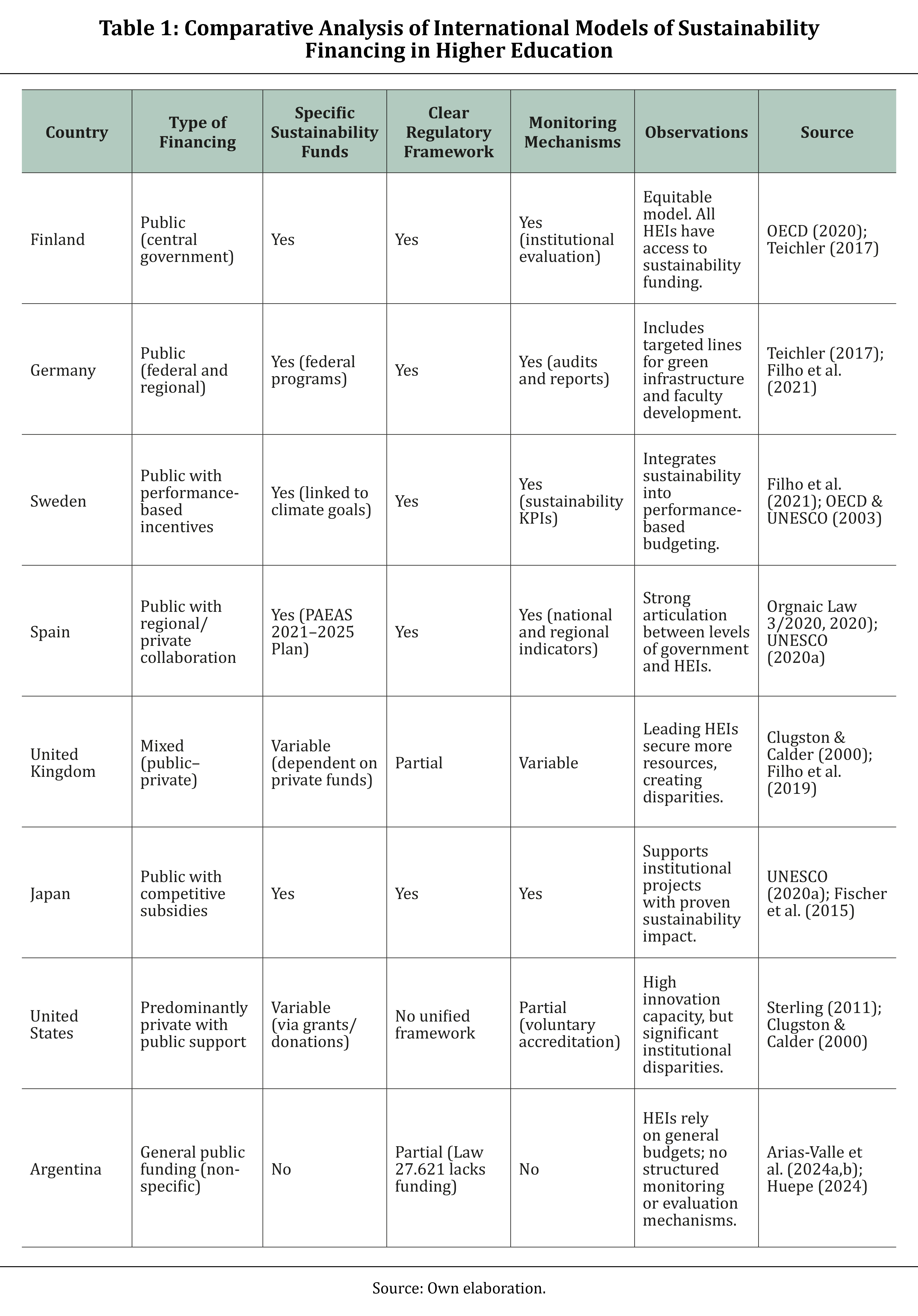
The comparison of Argentina’s regulatory frameworks and financing practices with international models revealed key divergences and offered significant lessons. Public versus Mixed Financing Models: In countries like Finland and Germany, where higher education is primarily financed by public funds, the implementation of sustainability policies in HEIs tends to be more equitable and sustained. These models ensure that all HEIs -regardless of their size or geographic location- have access to the necessary resources to advance sustainability initiatives. In contrast, mixed models as seen in the United States and the United Kingdom, which combine public and private funding, foster greater dynamism and innovation but also generate greater disparities in access
to resources.
Another model incorporates Strategies for Integrating ESD with Financing mechanisms: In countries with specific and detailed regulatory frameworks that include dedicated financing, such as Japan and Sweden, there is greater coherence and success in integrating ESD at all educational levels. In Argentina, the lack of clarity and specificity in financing has led to fragmentation, with significant variations among different HEIs and regions.
Good Practices in International Models: The Spanish Action Plan for Environmental Education 2021-2025 stands out as an example of good practices in integrating environmental education into national educational policies. This plan sets clear objectives and also details specific financing and support mechanisms for implementing sustainability policies in HEIs. Argentina could benefit from adopting elements of this model, especially in terms of allocating specific funds and designing a more rigorous monitoring and evaluation framework.
To further illustrate the differences between Argentina and international models, Table 1 presents a comparative analysis of financing mechanisms for sustainability in higher education institutions across selected countries. The table highlights the existence or absence of specific funding lines, regulatory clarity, monitoring systems, and the overall financing structures. This comparison provides valuable information for understanding the challenges addressed by Argentine HEIs and identifying potential strategies
for improvement.
3.6 International Recommendations and Their Applicability in Argentina
Recommendations from international organizations such as UNESCO and the OECD underline the urgent need to establish clear and sustainable financing mechanisms for ESD in HEIs in Argentina. These recommendations include allocating specific funds, promoting public-private collaboration, developing internal capacities, and adopting monitoring and evaluation frameworks.
Allocation of Specific Sustainability Funds: Creating dedicated financing lines within HEI budgets is essential to ensure adequate resource availability. These funds should be specifically oriented towards sustainability projects, including green infrastructure, sustainability training for educators, and applied research in ESD.
Promotion of Public-Private Collaboration: Encouraging alliances between HEIs, the private sector, and international organizations could diversify financing sources and increase HEIs’ financial resilience. Such collaboration should focus on areas such as innovation in sustainability, technology transfer, and joint research projects.
Development of Internal Capacities: Investing in ongoing training for educators and administrators is crucial to ensure that HEIs are equipped with the competencies required to implement and manage sustainability programs effectively. This involves both technical training and also the development of leadership and change management skills.
Adoption of a Monitoring and Evaluation Framework: Implementing a rigorous monitoring and evaluation system is essential to ensuring that resources are used efficiently and that HEIs can adjust their strategies based on the results obtained. This framework should include clear progress indicators and feedback mechanisms that allow for continuous improvement.
4. Discussion
This research, based on an exhaustive document analysis, reveals an apparent lack of specific quantitative empirical evidence on sustainability funding in HEIs in Argentina. However, this absence should not be interpreted as a limitation of the study, but rather as a central finding and a direct manifestation of the structural problem under analysis. The difficulty in finding detailed data on budget allocations for sustainability initiatives in Argentina reflects the absence of clear, specific, and sustained financing mechanisms (Arias-Valle & Marimon, 2025b). This gap serves as robust qualitative evidence of policy fragmentation and the low prioritization of sustainability initiatives within higher education funding.
The limited participation of Argentine universities in international rankings assessing institutional commitment to sustainability -such as THE-IR- further confirms this lack of support (Arias-Valle, 2024; Arias-Valle et al., 2024). The low representation of these institutions on such platforms demonstrates the absence of an appropriate financial framework for sustainability policies, as well as that these initiatives have yet to become a strategic priority for the majority of HEIs.
This situation is further compounded by the unequal implementation of such initiatives. Our study found that 73% of universities have not integrated sustainability policies into their strategic plans, a finding consistent with Arias-Valle (2025b), who also points out to the lack of specific funding for Argentine HEIs. This perpetuates a cycle of inequity, where institutions located in metropolitan areas or with access to international networks are in a better position to secure external funding, while those in less developed regions struggle to meet the established goals. Furthermore, previous studies have shown fragmentation in the incorporation of sustainability in Argentine HEIs across teaching, research, and extension, which limits its systemic impact (Arias-Valle & Marimon, 2025a; 2024). Therefore, this qualitative evidence confirms that the lack of a clear funding framework not only impedes the measurement of progress but also perpetuates inequities and hinders comprehensive integration, leaving institutions with fewer resources at a disadvantage in advancing toward the SDG.
This situation is exacerbated by the current political discourse in Argentina, which reinforces the structural absence of financial mechanisms to support sustainability in higher education. The president's rejection the United Nations' Pact for the Future and his criticism of multilateral financial institutions underscore a deliberate withdrawal from international frameworks that promote environmental education and the financing of sustainable development. The absence of national leadership aligned with global sustainability commitments further undermines the political coherence and financial prioritization required to implement sustainability programs in Argentine HEIs. As a result, universities operate in an increasingly fragmented regulatory environment, without guidance or funding structures that support the implementation of Education for Sustainable Development.
The document analysis conducted in this study suggest that regulatory frameworks in Argentina -such as the Law 27.621- provide an initial normative basis for environmental education, but lack the specificity and clarity required to ensure adequate and sustained financing. This deficiency becomes particularly evident when compared to regulatory frameworks in other countries -e.g., Finland and Germany- where sustainability in higher education is supported by specifically allocated funds and well-defined programs (Teichler, 2017). In these contexts, dedicated financing allows HEIs to implement sustainability policies equitably and effectively—a stark contrast to the current situation in Argentina.
The absence of specific financing mechanisms in Argentina has led HEIs to depend almost exclusively on general public funds. This lack of financial clarity limits the institutions' capacity to invest in sustainable infrastructure and develop educational sustainability programs, and it also perpetuates unequal implementation of these policies across HEIs. In contrast, countries such as Spain, Japan, and Sweden have implemented regulatory frameworks with clearly detailed funding sources and precise guidelines for their allocation and use (Lozano et al., 2015). These models provide valuable lessons for Argentina, emphasizing the need for a clearer and more specific financial structure.
The decentralized structure of the Argentine educational system, which grants HEIs considerable autonomy to develop their own sustainability approaches, has resulted in significant variability in the application of these policies. While decentralization can be seen as a mechanism to foster innovation and local adaptation, in practice it has led to notable disparities in HEIs' capacity to implement sustainability programs. Previous studies have concluded that without a clear financing framework and a solid monitoring system, decentralization can exacerbate inequalities among institutions (Sterling, 2004). This suggests that while institutional autonomy provides advantages, it must be balanced with adequate financial support and a coherent regulatory framework.
The comparison with international models also highlights the deficiencies of the Argentine system. In countries like the United States and the United Kingdom, public-private collaboration has been a fundamental pillar for financing sustainability in HEIs. These alliances allow institutions to diversify their income sources and access additional resources that can be used to drive innovation in key areas such as green infrastructure and applied sustainability research (Clugston & Calder, 2000). In Argentina, public-private collaboration is still at an early stage and marked by significant disparities among different HEIs. Institutions located in urban centers with a higher profile tend to have better opportunities to establish strategic alliances than those in more remote regions or with fewer resources, who deal with greater barriers (Arias-Valle et al., 2024). This situation limits these HEIs' capacity to advance in implementing sustainability policies, perpetuating a cycle of inequity that is difficult to break without more structured support from the government and other financing sources (Teichler, 2017).
A clear example of how good international practices can be adapted to the Argentine context is the Spanish National Action Plan for Environmental Education 2021-2025. This plan stands out for its clear objectives and specific financing mechanisms for incorporating sustainability initiatives in HEIs. It provides a clear roadmap for integrating sustainability policies into higher education and also establishes a monitoring and evaluation system to adjust them according to the results obtained (Lozano et al., 2015). Implementing a similar framework in Argentina could help overcome some of the current financial barriers and promote more coherent and equitable sustainability policies.
The ECLAC report highlights significant obstacles faced by HEIs in the region when implementing sustainability policies. Unlike more advanced economies, characterized by solid and permanent financial frameworks, in Latin America and the Caribbean the lack of adequate and sustained financing mechanisms significantly hinders the implementation of sustainable initiatives in HEIs (Huepe, 2024). This challenge is further exacerbated by reduced fiscal space and dependence on unstable tax revenues, factors that complicate the equitable and effective allocation of resources within the education sector. These findings highlight the need to rethink financing strategies in the region to ensure that sustainability policies are implemented uniformly and financially supported to be effective and enduring.
This study is supported by existing literature on sustainability initiatives in Argentine HEIs, which has repeatedly referred to the lack of adequate financing as a substantial barrier to the effective implementation of sustainable policies (González-Gaudiano, 2016; Huepe, 2024). While previous research has identified this limitation, few have delved into the need for a specific regulatory framework that not only acknowledges this shortfall but also proposes concrete and contextualized solutions to overcome it. Compared to studies like those by Lozano et al. (2015) and Sterling (2004) that explore barriers and opportunities for sustainability initiatives in a global context, this work offers a more localized and critical perspective, focusing on how the peculiarities of the Argentine education system amplify these challenges. By proposing specific indicators for monitoring and evaluation, as well as the creation of a national fund dedicated to sustainability, this study not only reinforces recommendations found in existing literature but also introduces new strategies adapted to the Argentine context. Thus, it positions itself as a key contribution to understanding the problems that offers a clear and viable way to overcome current barriers, opening new avenues for research and action in the field of education for sustainable development in Latin America.
From a practical perspective, the findings of this study highlight the urgent need to reform the Argentine regulatory framework to include clear financial mechanisms specifically dedicated to sustainability initiatives in higher education. Implementing a solid monitoring and evaluation system is equally essential to ensure that policies are applied effectively and also adjusted -as necessary- to address emerging disparities and challenges (Fischer et al., 2015). Without these specific financing mechanisms, HEIs will continue to depend almost exclusively on general public funds, which are insufficient to cover the particular needs of sustainability programs. This has resulted in unequal implementation of sustainability policies, with significant disparities between larger or better-connected institutions that can access additional resources and those in less favored regions that lack the means to advance in this area.
Finally, this study underscores the importance of investing in ongoing training of educators and administrators. Sustainable policies can only be as effective as the capacity of those implementing them. Investing in developing internal capacities is crucial to ensuring that HEIs not only adopt, but also maintain and improve, their sustainability initiatives. Specific training workshops and programs can provide educators and administrators with the necessary tools to successfully address sustainability challenges.
Theoretically, this study contributes to the debate on the effectiveness of decentralization in implementing educational policies, particularly in contexts where financing is limited. The results suggest that while decentralization can offer flexibility and adaptability, it can also lead to significant disparities in policy implementation if not supported by a solid financing framework and an effective monitoring system. These findings are consistent with existing literature highlighting the importance of balancing institutional autonomy with a coherent and equitable regulatory framework (Tilbury, 2011).
This study, based on document analysis, presents certain limitations inherent to this approach. Although it provides a detailed view of regulatory frameworks and financing practices in Argentina, it may not fully capture the emerging or undocumented dynamics in implementing sustainability policies in HEIs (Teichler, 2007, 2017). However, these limitations also offer an opportunity for future research that could address these issues from a broader empirical perspective, including case studies and more detailed comparative analyses that consider a larger number of variables and contexts.
5. Conclusion
The study highlights the urgent need to reform the Argentine regulatory framework to ensure adequate and sustained financing that enables effective implementation of sustainability policies in HEIs. The lack of specific financial mechanisms has significantly restricted HEIs' capacity to advance sustainability initiatives, perpetuating inequalities among institutions, especially within a decentralized system where institutional autonomy is not accompanied by the necessary resources.
To address these challenges, it is essential to establish a national fund dedicated exclusively to financing sustainability initiatives in HEIs. This fund, managed by a state agency in collaboration with HEIs, could finance green infrastructure projects, sustainability training programs, and applied research in sustainable development. The equitable distribution of these resources must be ensured through an evaluation committee that supervises and guides the allocation of funds according to each institution’s needs and merits.
Additionally, promoting collaboration amog HEIs, the private sector, and international organizations is fundamental. This synergy can be enhanced through tax incentives and the creation of cooperation networks that allow for sharing resources and knowledge. HEIs have the opportunity to establish agreements with companies committed to sustainability, which will not only benefit academia but also strengthen the link with industry, promoting more effective implementation of sustainable projects.
Another essential measure is implementing a rigorous monitoring and evaluation system for sustainability policies in HEIs. This system should include clear indicators and feedback mechanisms, allowing HEIs to report their progress in this area annually. The results of these evaluations should be a key criterion for allocating future resources, ensuring that the institutions most committed to and successful in sustainability receive the necessary support to continue and expand their initiatives.
To ensure that sustainability policies in Argentine HEIs are effective, it is crucial to implement a monitoring and evaluation system that uses specific and well-defined indicators. Some key monitoring indicators are: the proportion of the institutional budget dedicated to sustainability initiatives, the number and impact of research projects focused on sustainable development, the implementation of green infrastructure, and the continuous training of academic and administrative staff on sustainability issues.
Additionally, it is essential to assess progress in integrating sustainability in curricula and the extent of collaboration with external stakeholders, such as the private sector and international organizations. An annual public reporting system should be established to ensure transparency and accountability in this process, requiring HEIs to present their progress and be evaluated by an independent regulatory body. This body should have the authority to conduct audits and provide recommendations for improvement, ensuring that resources are used efficiently and that sustainability goals are met equitably and effectively across all institutions.
Another aspect to consider is the need to invest in ongoing training for educators and administrators on sustainability and project management issues. To this end, workshops and courses should be organized in collaboration with national and international experts, providing university staff with the competencies required to effectively implement and manage sustainability projects. This internal capacity building is crucial to ensure both the effective implementation of adopted policies as well as their continuity and development over time.
Finally, it is necessary to review and update the Law 27.621 to include clear and specific guidelines for the financing of sustainability initiatives in HEIs. Amendments to the law should specify minimum financing amounts, eligibility criteria for accessing the funds, and the responsibilities of HEIs regarding the implementation of sustainable policies. Only with a strengthened and clearly defined regulatory framework will Argentine HEIs be able to overcome current limitations and move forward towards an educational model that is truly aligned with the SDGs.
These actions will not only improve equity in the implementation of sustainability policies but also strengthen HEIs' capacity to contribute to the country's socio-economic and environmental development. It is essential that policymakers and institutions work in a coordinated manner and with a clearly defined commitment to sustainability, ensuring that adopted policies have a lasting and transformative impact on Argentine higher education.
References
Al-Filali, I. Y.; Abdulaal, R. M. S.; Alawi, S. M. & Makki, A. A. (2024). Modification of strategic planning tools for planning financial sustainability in higher education institutions. Journal of Engineering Research, 12(1), 192-203. https://doi.org/10.1016/j.jer.2023.11.015
Amorós Molina, Á.; Helldén, D.; Alfvén, T.; Niemi, M.; Leander, K.; Nordenstedt, H.; Rehn, C.; Ndejjo, R.; Wanyenze, R. & Biermann, O. (2023). Integrating the United Nations sustainable development goals into higher education globally: a scoping review. Global Health Action, 16(1). https://doi.org/10.1080/16549716.2023.2190649
Archer, D. (2023). Transforming the financing of education at the mid-point of the sustainable development goals. International Journal of Educational Development, 103, 102931. https://doi.org/10.1016/j.ijedudev.2023.102931
Arias-Valle, M. B. & Marimon, F. (2025a). Do Argentine Universities Incorporate Sustainability in Their Extension Activities? Luna Azul, 59, 172-194. https://doi.org/10.17151/luaz.2024.59.9
Arias-Valle, M. B. & Marimon, F. (2025b). The engagement with sustainability: The case of the Argentine university system. Educación y Humanismo, 27(49), 1-24. https://doi.org/10.17081/eduhum.27.49.7385
Arias-Valle, M. B.; Lillo Murcia, A. M.; Perez Armendariz, M. P.; Ocampo Abadía, A. A.; Gamez, D.; Arias Marquez, M. T.; Zamora, S. & Maluf, M. (2024a). El compromiso de las universidades con la sostenibilidad. El caso del sistema universitario Argentino. Revista Del Congrés Internacional de Docència Universitària i Innovació (CIDUI), 0(6 SE-CIDUI 2023).
Arias-Valle, M. B. (2024). Performance of Argentine Universities in International Sustainability rankings. Revista Estudio Ambientales, 12(2), 64-80. https://doi.org/10.47069/estudios-ambientales.v12i2.2773
Arias-Valle, M. B. & Marimon, F. (2024). Do Argentine Higher Education Institutions promote sustainability? Revista Andina de Educación, 8(1), 000812-000812. https://doi.org/10.32719/26312816.2024.8.1.2
Arias-Valle, M. B.; Marimon, F.; Coria-Augusto, C. J. & Apaza-Canquí, A. E. (2024). Perspectives on Sustainability in Higher Education: A Comparative Analysis between Argentina, Spain, and Peru. Revista de Investigación En Educación, 22(3), 604-620. https://doi.org/10.35869/REINED.V22I3.5768
Arias-Valle, M. B.; Marimon, F.; Coria-Augusto, C. J. & Apaza-Canquí, A. E. (2024b). Perspectives on Sustainability in Higher Education: A Comparative Analysis between Argentina, Spain, and Peru. Revista de Investigación En Educación, 22(3), 604-620. https://doi.org/10.35869/REINED.V22I3.5768
Bowen, G. A. (2009). Document Analysis as a Qualitative Research Method. Qualitative Research Journal, 9(2), 27-40. https://doi.org/10.3316/QRJ0902027
Brundtland, G. H. (1987). Our Common Future-Call for Action. Environmental Conservation, 14(4), 291-294. https://doi.org/DOI: 10.1017/S0376892900016805
Clugston, R. R. M., & Calder, W. (2000). Critical dimensions of sustainability in higher education. Sustainability and University Life, 31-46.
Cortese, A. D. (2003). The Critical Role of Higher Education in Creating a Sustainable Future. Planning for Higher Education, 15-22.
Elkington, J. (1998). Cannibals with Forks: The Triple Bottom Line of 21st Century Business. Gabriola Island, BC. Environmental Quality Management, 8, 37-51. https://doi.org/10.1002/tqem.3310080106
Ferguson, T. & Roofe, C. G. (2020). SDG 4 in higher education: challenges and opportunities. International Journal of Sustainability in Higher Education, 21(5), 959-975. https://doi.org/10.1108/IJSHE-12-2019-0353/FULL/XML
Filho, W. L.; Amaro, N.; Avila, L. V.; Brandli, L.; Damke, L. I.; Vasconcelos, C. R. P.; Hernandez-Diaz, P. M.; Frankenberger, F.; Fritzen, B.; Velazquez, L. & Salvia, A. (2021). Mapping sustainability initiatives in higher education institutions in Latin America. Journal of Cleaner Production, 315, 128093. https://doi.org/10.1016/j.jclepro.2021.128093
Filho, W. L.; Will, M.; Salvia, A. L.; Adomßent, M.; Grahl, A. & Spira, F. (2019). The role of green and Sustainability Offices in fostering sustainability efforts at higher education institutions. Journal of Cleaner Production, 232, 1394-1401. https://doi.org/10.1016/J.JCLEPRO.2019.05.273
Fischer, D., Jenssen, S., & Tappeser, V. (2015). Getting an empirical hold of the sustainable university: a comparative analysis of evaluation frameworks across 12 contemporary sustainability assessment tools. Assessment & Evaluation in Higher Education, 40(6), 785–800. https://doi.org/10.1080/02602938.2015.1043234
González-Gaudiano, E. J. (2016). ESD: Power, politics, and policy: «Tragic optimism» from Latin America. The Journal of Environmental Education, 47(2), 118-127. https://doi.org/10.1080/00958964.2015.1072704
Huepe, M. (2024). El desafío de la sostenibilidad financiera de la educación en América Latina y el Caribe.
IESALC & UNESCO (2023). General guidelines for the implementation of sustainability in higher education institutions – SET4HEI. IESALC.
IIEP & UNESCO. (2017). Planning education, building the future: 10th Medium-term strategy, 2018-2021 (of International Institute for Educational Planning) (p. 20). UNESCO-IIEP.
Ley 27.621 (3 de junio de 2021). Ley Nacional de Educación Ambiental Integral. Gobierno de Argentina. https://www.argentina.gob.ar/normativa/nacional/ley-27621-350594/texto
Lozano, R.; Ceulemans, K.; Alonso-Almeida, M.; Huisingh, D.; Lozano, F. J.; Waas, T.; Lambrechts, W.; Lukman, R. & Hugé, J. (2015). A review of commitment and implementation of sustainable development in higher education: results from a worldwide survey. Journal of Cleaner Production, 108, 1-18. https://doi.org/ https://doi.org/10.1016/j.jclepro.2014.09.048
Lozano, R.; Lukman, R.; Lozano, F. J.; Huisingh, D. & Lambrechts, W. (2013). Declarations for sustainability in higher education: becoming better leaders, through addressing the university system. Journal of Cleaner Production, 48, 10-19. https://doi.org/https://doi.org/10.1016/j.jclepro.2011.10.006
OECD & UNESCO (2003). Financing Education– Investments And Returns. In OECD/UNESCO.
Siqueira, A. C. de (2012). The 2020 World Bank Education Strategy. In The World Bank and Education (pp. 69-81). SensePublishers. https://doi.org/10.1007/978-94-6091-903-9_5
Organic Law 3/2020, of December 29, amending Organic Law 2/2006, of May 3, on Education. Official State Gazette, No. 340, of December 30, 2020, pp. 122868–122953. https://www.boe.es/eli/es/lo/2020/12/29/3
Sterling, S. (2004). Higher Education, Sustainability, and the Role of Systemic Learning. In Higher Education and the Challenge of Sustainability (pp. 49-70). https://doi.org/10.1007/0-306-48515-x_5
Sterling, S. (2011). Transformative learning and sustainability: Sketching the conceptual ground. Learning and Teaching in Higher, 5(11), 17-33.
Teichler, U. (2007). Higher Education Systems: Conceptual frameworks, comparative perspectives, empirical findings. In Bill, (9).
Teichler, U. (2017). Recent changes of financing higher education in Germany and their intended and unintended consequences. International Journal of Educational Development, 58. https://doi.org/10.1016/j.ijedudev.2016.10.008
Montenegro de Lima, C. R., Coelho Soares, T., Andrade de Lima, M., Oliveira Veras, M., & Andrade Guerra, J. B. S. O. de A. (2020). Sustainability funding in higher education: A literature-based review. International Journal of Sustainability in Higher Education, 21(3), 441–464. https://doi.org/10.1108/IJSHE-07-2019-0229
Tünnermann, C. (1998). La reforma universitaria de Córdoba. Educación Superior y Sociedad, 9(1), 103-127. http://beu.extension.unicen.edu.ar/xmlui/handle/123456789/272
UNESCO (2017). Education for Sustainable Development Goals: learning objectives. UNESCO.
UNESCO (2020a). Education for sustainable development: a roadmap. UNESCO.
UNESCO (2020b). Education for sustainable development for 2030 toolbox.
UNESCO (2020c). Global education monitoring report summary, 2020: Inclusion and education: all means all.
UNESCO. (2021). Examining non-state actors’ contributions to international higher education scholarships (p. 34).
Author Contributions (CRediT):
|
María Belén Arias-Valle
Doctor of Economics from the Universitat Internacional de Catalunya, Spain. Professor and Researcher at the Universidad Católica de Cuyo, San Juan, Argentina. Director of the Institute for Sustainable Development at the Universidad Católica de Cuyo. Postdoctoral Fellow of CONICET (National Scientific and Technical Research Council).
|
Frederic Marimon
|
Revista Kawsaypacha: Sociedad y Medio Ambiente.
N° 16 julio – diciembre 2025. E-ISSN: 2709 – 3689
| Cómo citar: Arias-Valle, M. B., & Marimon, F. Higher Education and Sustainability. The Challenge of Financing in Argentina. Revista Kawsaypacha: Sociedad Y Medio Ambiente, (16). https://doi.org/10.18800/kawsaypacha.202502.A005 | |