
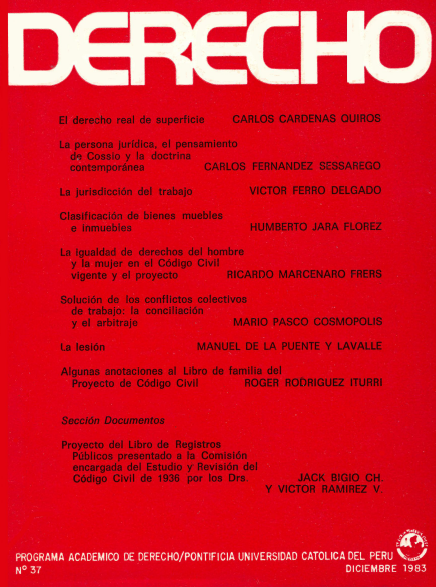
Classification of Movable and Immovable Property
DOI:
https://doi.org/10.18800/derechopucp.198301.004Keywords:
Movable and immovable property, mortgage, pledge, credit, rightsAbstract
In Roman Law, the classification of property into movable and immovable has responded to a criterion of mobility corresponding to the nature and physical characteristics of things. On the other hand, in the old French Law, the classification criterion was mainly based on an economic criterion, in which the value, the duration and the possibility of the goods to produce income periodically predominated. With the implementation of the French Civil Code (1804), the division between movable and immovable property acquired universality, being repeated in almost all Western legislations. However, in this paper we recognize that this classification has certain shortcomings, especially because it doesn’t meet all current requirements. Thus, its ineffectiveness is criticized, as well as the ineffectiveness of Peruvian legislation because it’s based on it. In this line, it’s proposed to replace this classic classification, based on the usefulness that these rights and/or goods have for society, duly organizing the guarantees, so necessary in a credit-based economy.
Downloads
References
Biondi, B. (1961). Los bienes. Bosch.
Colin, A. y Capitant, H. (1923). Curso Elemental de Derecho Civil (Tomo II, Volumen II). Reus.
De Trazegnies, F. (1982, 21 de diciembre). Bienes, Naturaleza y Romanos. El Comercio.
Josserand, L. (1950). Derecho Civil (Tomo I, Volumen III). Ediciones Jurídicas Europa-América (EJEA).
Mazeaud, H., Mazeaud, L. y Mazeaud, J. (1962). Lecciones de Derecho Civil (Volumen I). Ediciones Jurídicas Europa-América.
Planiol, M. (1955). Tratado Elemental de Derecho Civil. Cajica S.A.
Vallet, J. (1973). Estudios sobre Garantías Reales. Montecorvo S.A.
Downloads
Published
Issue
Section
License
Copyright (c) 2016 Derecho PUCP

This work is licensed under a Creative Commons Attribution 4.0 International License.
