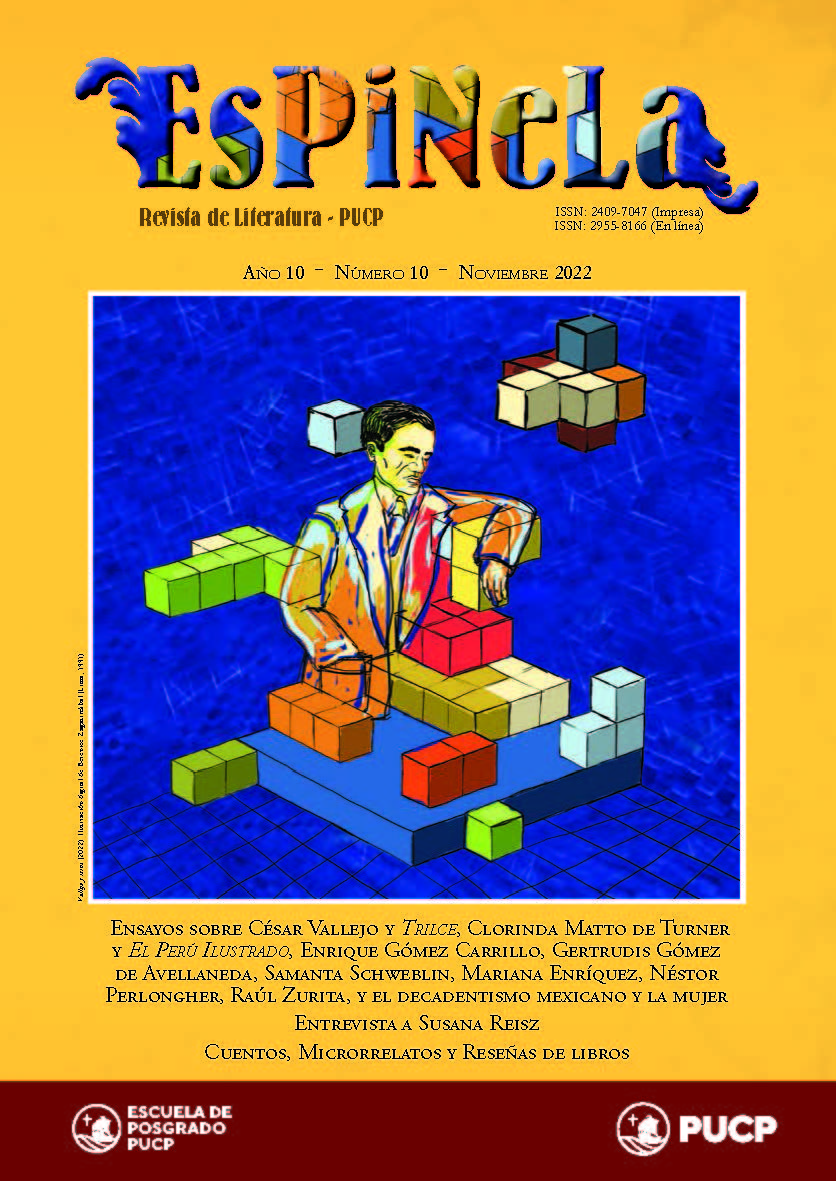
The place that I know: the construction of the third space in “Trilce”
Keywords:
Vallejo, Third space, Trilce, Heterotopia, Avant-gardeAbstract
Peruvian and international critics (Coyné, Neale-Silva, Ortega, Sicard) have seen in the poem XXXVI, and especially in the incomplete image of the Venus de Milo, a poetics of Trilce (1922), which is based on a new aesthetic, that of the imperfect, the uncertain, the unspeakable, a poetics of the odd. To complete this idea, the work focuses on the poem titled “Trilce”, published in Spain in 1923, the only one that, not being part of the book, bears that title and is installed in a space outside the 67 poems that make up Trilce. From there, the poem functions as a heterotopia, following Foucault: a meta-reflection on the book to which it refers as it is a mirror (heterotopic space), a reflection (virtual space) and, at the same time, a utopian, but concrete space. in his poetic praxis. Analyzing the production of these spaces, and of the “third space” as Soja and Bhabha define it, will serve to bring us closer to that space “where we will never reach.”
Downloads