
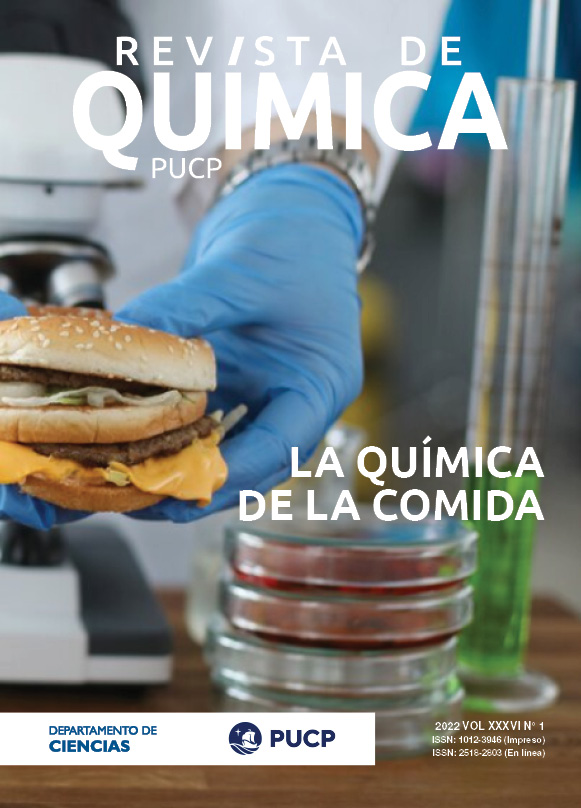
Chemistry on your plate: food preservatives
Keywords:
Preservatives, Preservation techniques, Parabenes, Peptides, BromatologyAbstract
Preservatives and preservation techniques give us access to the rich flavors of fresh food we all love while being away from the fields. Preservation techniques have been known since antiquity but they became more sophisticated after the Industrial Revolution as cities became more populous. Nowadays, preservatives are part of our daily life. They have become even more important as our society reaches for sustainability and food waste reduction. But the reader probably has a burning question: are they safe? The short answer is yes, they are safe. Let’s take a look at the history and chemistry of some of the most common chemicals used in food preservation techniques. With this information, the readers can decide on their own.
Downloads
References
(1) Morgan, M. Plutarch's Morals; W. Taylor, 1718.
(2) Butters, L. J. C. Salineras de Maras. Peru, 2019. https://patrimoniomundial.cultura.pe/sites/default/files/li/pdf/5.%20Salineras%20de%20Maras%20-%20Esp_reduce.pdf
(3) Flad, R.; Zhu, J.; Wang, C.; Chen, P.; von Falkenhausen, L.; Sun, Z.; Li, S. Archaeological and chemical evidence for early salt production in China. Proc. Natl. Acad. Sci. U.S.A. 2005, 102 (35), 12618-12622. https://doi.org/10.1073/pnas.0502985102
(4) Brown, I. W. Salt manufacture and trade from the perspective of Avery Island, Louisiana. MidCont. J. Archaeol. 1999, 24 (2), 113-151. https://www.jstor.org/stable/20708115
(5) Jurafsky, D. The Language of Food: A Linguist Reads the Menu; W. W. Norton, 2014.
(6) de Porres, L. U. S. M. Cultura, identidad y cocina en el Perú; Planeta Perú, 2018.
(7) Russell, D. G.; Vanderven, B. C.; Glennie, S.; Mwandumba, H.; Heyderman, R. S. The macrophage marches on its phagosome: dynamic assays of phagosome function. Nat. Rev. Immunol. 2009, 9 (8), 594-600. https://doi.org/10.1038/nri2591
(8) Blum, D. The Poison Squad: One Chemist's Single-Minded Crusade for Food Safety at the Turn of the Twentieth Century; Penguin Publishing Group, 2018.
(9) Portelinha, J.; Duay, S. S.; Yu, S. I.; Heilemann, K.; Libardo, M. D. J.; Juliano, S. A.; Klassen, J. L.; Angeles-Boza, A. M. Antimicrobial Peptides and Copper(II) Ions: Novel Therapeutic Opportunities. Chem. Rev. 2021, 121 (4), 2648-2712. https://doi.org/10.1021/acs.chemrev.0c00921.
(10) Irving, H.; Williams, R. J. P. 637. The stability of transition-metal complexes. J. Chem. Soc. 1953, (0), 3192-3210, 10.1039/JR9530003192. https://doi.org/10.1039/JR9530003192
(11) Rae, T. D.; Schmidt, P. J.; Pufahl, R. A.; Culotta, V. C.; O'Halloran, T. V. Undetectable intracellular free copper: the requirement of a copper chaperone for superoxide dismutase. Science 1999, 284 (5415), 805-808. https://doi.org/10.1126/science.284.5415.805
(12) Johnson, G. F. The early history of copper fungicides. Agric. Hist. 1935, 9 (2), 67-79. https://www.jstor.org/stable/3739659
(13) Tang, X.; Bai, Y.; Duong, A.; Smith, M. T.; Li, L.; Zhang, L. Formaldehyde in China: production, consumption, exposure levels, and health effects. Environ. Int. 2009, 35 (8), 1210-1224. https://doi.org/10.1016/j.envint.2009.06.002
(14) Weems, J.; Mead, I.; Gray, C. The chemical composition of food preservatives. Solutions for testing cream and milk. Experiment station, Iowa State College 1902, 67, 259-272.
(15) Cappuccio, F. P. Salt and cardiovascular disease. BMJ 2007, 334 (7599), 859. https://doi.org/10.1136/bmj.39175.364954.BE .
(16) Golden, R.; Gandy, J.; Vollmer, G. A Review of the Endocrine Activity of Parabens and Implications for Potential Risks to Human Health. Crit. Rev. Toxicol. 2005, 35 (5), 435-458. https://doi.org/10.1080/10408440490920104.
(17) Soni, M. G.; Carabin, I. G.; Burdock, G. A. Safety assessment of esters of p-hydroxybenzoic acid (parabens). Food Chem. Toxicol. 2005, 43 (7), 985-1015. https://doi.org/10.1016/j.fct.2005.01.020.
(18) Cetinić, K. A.; Grgić, I.; Previšić, A.; Rožman, M. The curious case of methylparaben: Anthropogenic contaminant or natural origin? Chemosphere 2022, 294, 133781. https://doi.org/10.1016/j.chemosphere.2022.133781.
(19) Robinson, R. K.; Batt, C. A.; Patel, P. Encyclopedia of Food Microbiology; Elsevier Science, 2014.
(20) Leppert, B.; Strunz, S.; Seiwert, B.; Schlittenbauer, L.; Schlichting, R.; Pfeiffer, C.; Röder, S.; Bauer, M.; Borte, M.; Stangl, G. I.; et al. Maternal paraben exposure triggers childhood overweight development. Nature communications 2020, 11 (1), 561. http://doi.org/10.1038/s41467-019-14202-1
(21) Rollema, H. S.; Kuipers, O. P.; Both, P.; de Vos, W. M.; Siezen, R. J. Improvement of solubility and stability of the antimicrobial peptide nisin by protein engineering. Appl. Environ. Microbiol. 1995, 61 (8), 2873-2878. https://doi.org/10.1128/aem.61.8.2873-2878.1995
(22) Martín, M. E. S.; Calvo, M.-T. S.; Hernández, Á. S. M.; Julián, J. P.; Barbero, E. R.; Martín, R. P.; Lobato, P. C. Nisina (N 234), aditivo utilizado como conservante en alimentos. 2019.
(23) Additives, E. Panel o. F.; Food, N. S. a. t.; Younes, M.; Aggett, P.; Aguilar, F.; Crebelli, R.; Dusemund, B.; Filipič, M.; Frutos, M. J.; Galtier, P.; et al. Safety of nisin (E 234) as a food additive in the light of new toxicological data and the proposed extension of use. EFSA Journal 2017, 15 (12), e05063. https://doi.org/10.2903/j.efsa.2017.5063.
(24) Libardo, M. D. J.; de la Fuente-Nuñez, C.; Anand, K.; Krishnamoorthy, G.; Kaiser, P.; Pringle, S. C.; Dietz, C.; Pierce, S.; Smith, M. B.; Barczak, A.; et al. Phagosomal Copper-Promoted Oxidative Attack on Intracellular Mycobacterium tuberculosis. ACS Infect. Dis. 2018, 4 (11), 1623-1634. http://doi.org/10.1021/acsinfecdis.8b00171.
(25) Juliano, S. A.; Serafim, L. F.; Duay, S. S.; Heredia Chavez, M.; Sharma, G.; Rooney, M.; Comert, F.; Pierce, S.; Radulescu, A.; Cotten, M. L.; et al. A Potent Host Defense Peptide Triggers DNA Damage and Is Active against Multidrug-Resistant Gram-Negative Pathogens. ACS Infect. Dis. 2020, 6, 1250-1263. http://doi.org/10.1021/acsinfecdis.0c00051
(26) Prince, A.; Sandhu, P.; Ror, P.; Dash, E.; Sharma, S.; Arakha, M.; Jha, S.; Akhter, Y.; Saleem, M. Lipid-II Independent Antimicrobial Mechanism of Nisin Depends On Its Crowding And Degree Of Oligomerization. Sci. Rep. 2016, 6 (1), 37908. http://doi.org/10.1038/srep37908
(27) Delves-Broughton, J.; Weber, G. 3 - Nisin, natamycin and other commercial fermentates used in food biopreservation. In Protective Cultures, Antimicrobial Metabolites and Bacteriophages for Food and Beverage Biopreservation, Lacroix, C. Ed.; Woodhead Publishing, 2011; pp 63-99.
Downloads
Published
Issue
Section
License
Copyright (c) 2022 Alfredo M Ángeles-Boza

This work is licensed under a Creative Commons Attribution 4.0 International License.