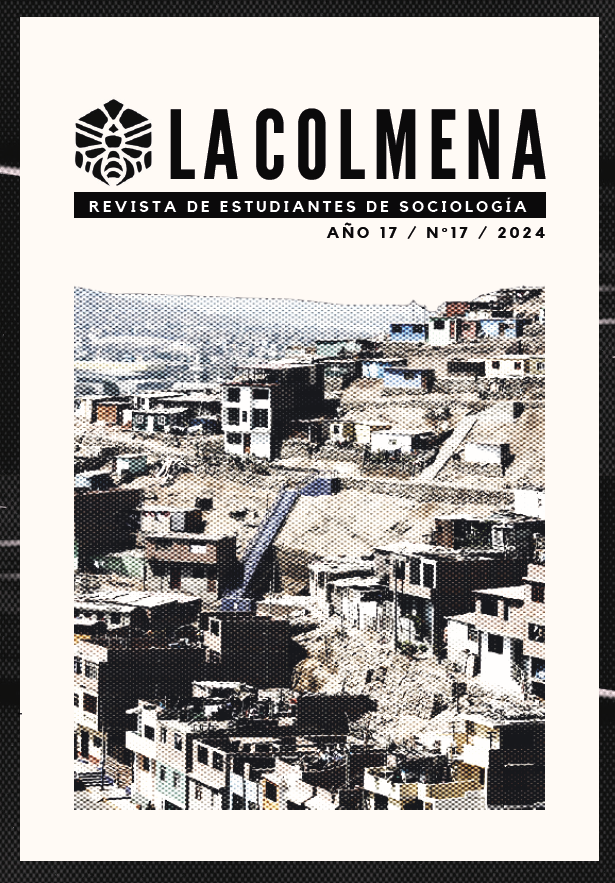
Representation of the 1940-60’s Lima city from the point of view of criticism in the literature of Julio Ramón Ribeyro and Enrique Congrains and its scope in the 21st century
DOI:
https://doi.org/10.18800/lacolmena.202401.002Keywords:
Lima, Julio Ramón Ribeyro, Enrique Congrains, Urban segregation, Social-urban criticismAbstract
Cities, just as living organisms, are entities of change and evolution. They change according to time, context and its inhabitants (Jacobs, 1961). This way, it can be stated that Lima city has undergone several transformation processes throughout its history. All of them started with different society-changing factors: population growth, migrations, economic crisis, social movements, labor supply and demand, and others. Particularly, the 20th century was determined by the large number of migration processes and its consequences in urban development. Therefore, it was the time period where most changes occurred in Lima city (Calderón, 2003; Matos, 1984). In this precise context, the 50’s generation, a literary movement characterized by the use of urban neorealism, establishes and develops its literary criticism of Lima city: a hostile and chaotic town that has its foundation in a social hierarchy which determines development factors that led to a low level of living quality and discrimination. This research focuses on analyzing the social criticism developed in two of the most important exponents of that generation’s work. Through their texts, it examines how marginalization and marginality act as crucial factors in the configuration of urban segregation in Lima between the 40’s and 60’s. Likewise, it seeks to understand how these social problems have evolved and persisted over time, shaping a 21st-century Lima that continues to face the problems denounced by Ribeyro’s and Congrains’ works, especially in relation to urban fragmentation, economic exclusion and the dynamics of inequality. In addition, it explores how discrimination, maily marked by ethnic and social factors in the 50’s, has evolved into an economic discrimination that continues to deeply divide the city.
Downloads