
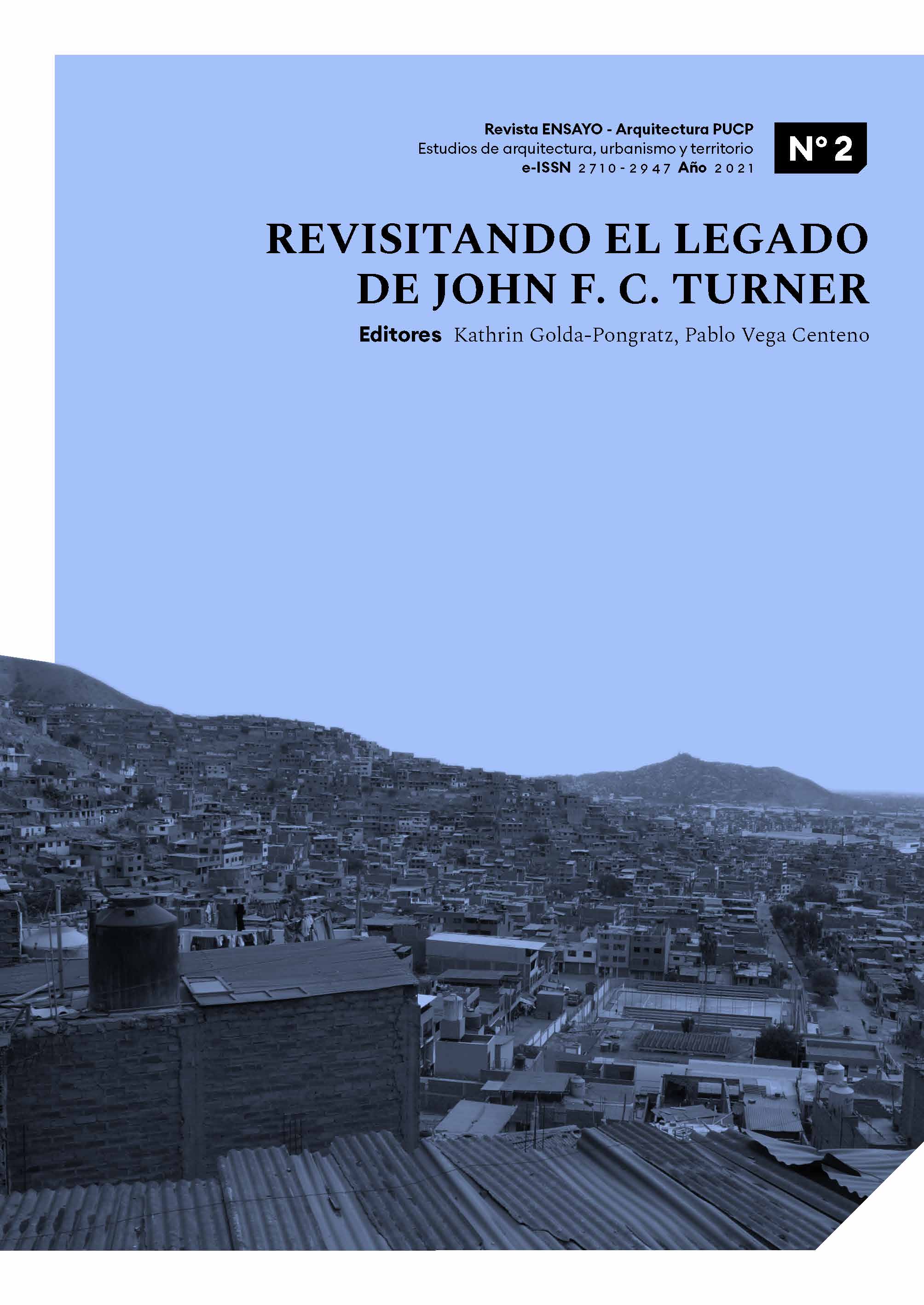
Examinando la relación entre la planeación y la urbanización periférica en Lima
DOI:
https://doi.org/10.18800/ensayo.202102.004Keywords:
Planning, Informality, Peripheral urbanisation, Urban land, Risk, LimaAbstract
Highlighting the particularities of the urbanisation of the peripheral slopes of Lima, this paper offers a counterpoint in three main fronts to the way auto-constructed settlements are often approached. Firstly it challenges the approach through informality arguing that in effect this lens places human settlements out of focus: on the one hand, it hides the hybridity of conditions involved in such processes of urbanisation; on the other, it positions these settlements tangentially to «formal» legal structures thus limiting the possibility of advancing an understanding of the relationship between planning and «informal» urbanisation processes. Although many cities of the global South get built through this form, this mode of urbanisation is predominantly seen to occur outside of, in violation of, or as a failure of planning.
Secondly, the paper questions unintended outcomes and more specifically the production and reproduction of risk as separate from planning, often positioned as the result of haphazard land occupation and lack of knowledge and technical capacities of auto-constructors.
Thirdly, it challenges the attribution of responsibility for «informal» urbanisation processes to the urban poor, calling for a relational as well as a socio-material perspective to better understand the urbanisation of the slopes.
Downloads
Downloads
Published
How to Cite
Issue
Section
License

This work is licensed under a Creative Commons Attribution-NonCommercial-ShareAlike 4.0 International License.