
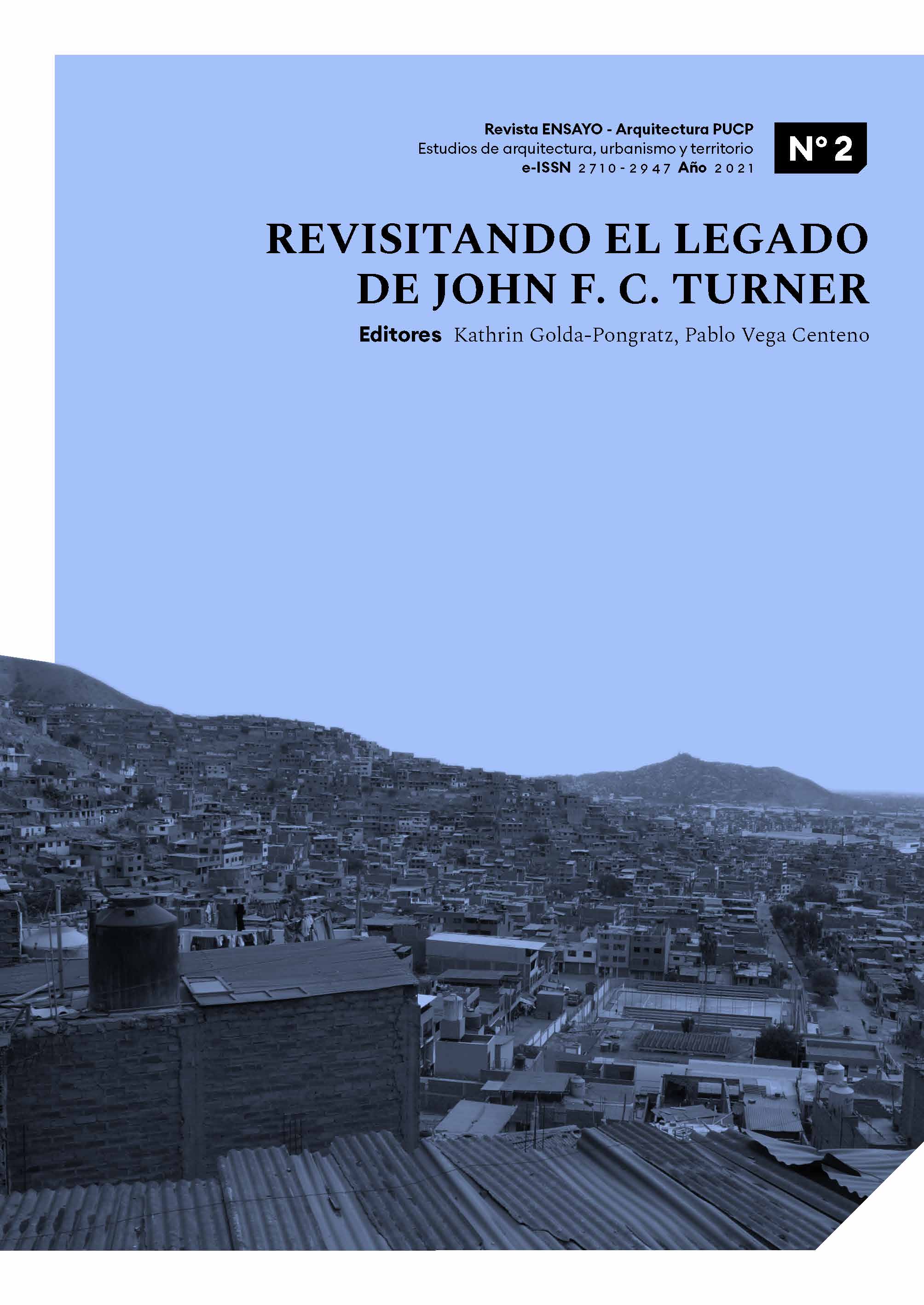
Hacia un urbanismo holístico: legado y topicalidad del pensamiento de John F. C. Turner en los asentamientos autoconstruidos del Cono Norte, Lima. El Ermitaño y Pampa de Cueva como casos de estudio para la activación de memoria urbana
DOI:
https://doi.org/10.18800/ensayo.202102.005Keywords:
John F. C. Turner, Placemaking, Holistic urbanism, Urban memory, Cono Norte, LimaAbstract
The increasing urban fragmentation and the lack of a holistic and inclusive vision of large Latin American agglomerations are, at the same time, their main contemporary challenges. The potential and value of community building and the need to include urban self-building that architect John F. C. Turner in his years in Peru described as «housing resources» and «architecture that works» remain unrecognized in the Peruvian urban and territorial planning.
Starting from the documentary A Roof of My Own (Turner & Movshon, 1964), filmed by the United Nations on the process of self-construction of El Ermitaño, in the Northern Cone of Lima, in 2016 a memory activation project has begun in the neighborhood.
It is the basis of a new documentary entitled City Unfinished. Voices of El Ermitaño (Golda-Pongratz & Flores, 2018), portraying this same place from a contemporary perspective that the author understands as a tool of placemaking. On the one hand, it is a question of understanding the current socio-urban dynamics by resorting to the urban memory of the inhabitants. On the other hand, it tests to what extent a less well-known part of Turner's work, his thinking toward a holistic concept of building places and his work on a universal tool to explain placemaking processes, will be applicable in emblematic places such as Pampa de Cueva or El Ermitaño on the self-built periphery of Lima.
This documentary and research work encompasses the entire territory of Lima as an interrelated system and seeks to design strategies with which all inhabitants, especially in key, ecologically important and physical areas actively participate as actors and actors responsible for the protection of the cultural heritage and the ecological balance of their habitat.
Downloads
Downloads
Published
How to Cite
Issue
Section
License

This work is licensed under a Creative Commons Attribution-NonCommercial-ShareAlike 4.0 International License.