


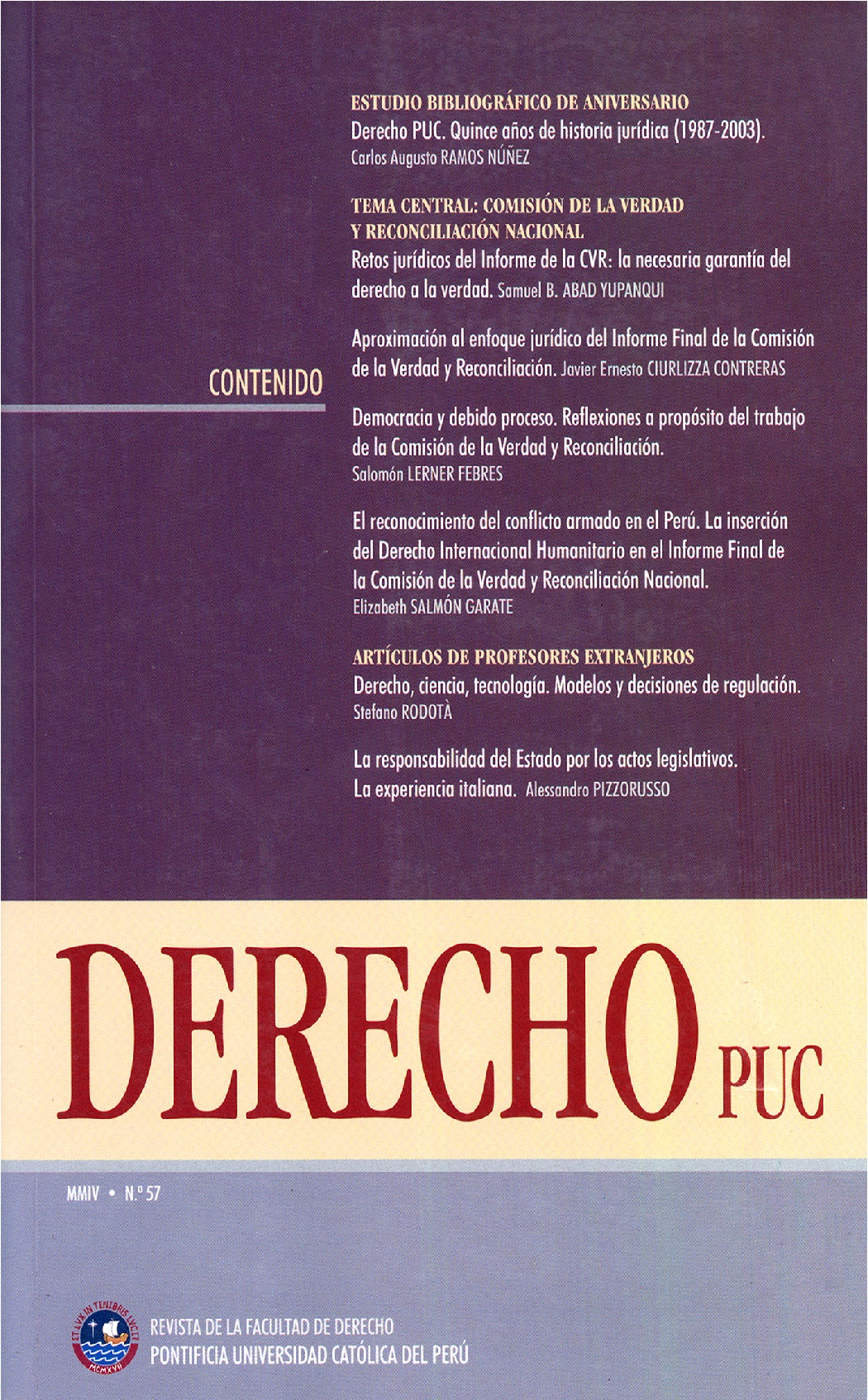
Democracy and Due Process: Reflections on the Work of the Truth and Reconciliation Commission
DOI:
https://doi.org/10.18800/derechopucp.200401.004Keywords:
Truth and Reconciliation Commission, Democracy, Due Process, Human Rights, Terrorism, JusticeAbstract
This paper addresses the complex relationship between democracy, justice, and due process in the context of the fight against terrorism and subversion that kept Peru in a climate of anxiety during the 1980s and 1990s. It highlights the need to critically analyze whether the laws and judicial practices employed during that period were truly fair and respectful of the rule of law. The author therefore stresses the importance of defending democracy from those who seek to undermine it. However, it is crucial that such protection be carried out with respect for legal principles, the life and integrity of individuals. Consequently, judicial methods must be used that seek the truth and do not violate human rights. In short, it is proposed that the defense of democracy must be carried out within a legal framework that respects democratic principles and human rights, particularly in conflict situations.
Downloads
Downloads
Published
How to Cite
Issue
Section
License
Copyright (c) 2016 Derecho PUCP

This work is licensed under a Creative Commons Attribution 4.0 International License.
