


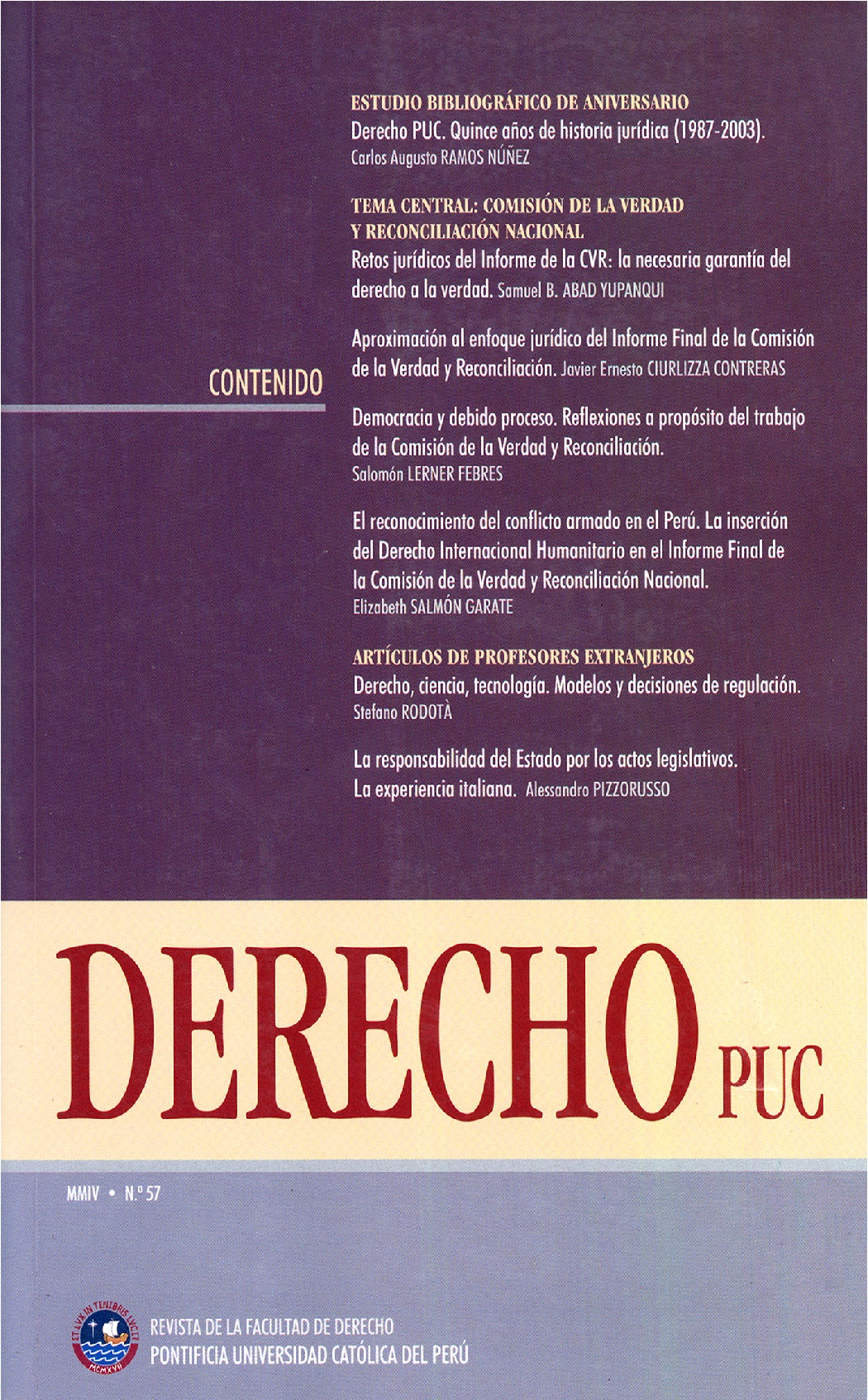
El reconocimiento del conflicto armado en el Perú: la inserción del derecho internacional humanitario en el Informe Final de la Comisión de la Verdad y Reconciliación Nacional
DOI:
https://doi.org/10.18800/derechopucp.200401.005Palavras-chave:
Comisión de la Verdad y Reconciliación, Conflicto Armado Interno, Derecho Internacional Humanitario, Normas Humanitarias, Principios AplicablesResumo
En el contexto de los conflictos armados internacionales como no internacionales -como fue el caso del Perú-, sin importar las razones que los hayan originado, existe la obligación de aplicar normas humanitarias. Esto implica que ninguna situación justifica la perpetración de actos violentos que infrinjan las normas del Derecho Internacional Humanitario (DIH). Esta concepción ha sido recogida en el Informe Final de la Comisión de la Verdad y Reconciliación (CVR). En esa línea, y debido a las características que presentó el conflicto que mantuvo en zozobra al Perú durante el periodo de 1980 y 2000, se han establecido un conjunto de normas y principios aplicables a este tipo de casos. Entre tales normas, destaca principalmente el artículo 3 común a los cuatro Convenios de Ginebra. Este artículo alberga disposiciones que recogen principios humanitarios fundamentales los cuales buscan proteger la dignidad humana y además tienen un carácter consuetudinario. Finalmente, se concluye señalando que las obligaciones impuestas por el DIH y el artículo 3 común deben ser cumplidas tanto por los grupos subversivos como las fuerzas del estado.
Downloads
Referências
Arquéz Carrasco, M. del C. (1998). Problemas actuales sobre la prohibición del recurso a la fuerza en Derecho internacional. Tecnos.
Betiati, M. (2000). Droit humanitaire. París: Éditions du Seuil.
Comisión de la Verdad y Reconciliación. (2003). Capítulo 4: La dimensión jurídica de los hechos. En Informe Final de la Comisión de la Verdad y Reconciliación (pp. 195-247).
Comisión Interamericana de Derechos Humanos. (1997). Informe N.º 55/97. En Informe anual 1997. Organización de los Estados Americanos. https://cidh.oas.org/annualrep/97span/97indice.htm
Comisión Interamericana de Derechos Humanos. (2002). Informe sobre Terrorismo y Derecho internacional humanitario. AG/RES/1906 (XXXII-0/02), 4 de junio de 2002.
Corte Internacional de Justicia. (1986). Caso de las Actividades Militares y Paramilitares en y contra Nicaragua, junio de 1986.
Corte Internacional de Justicia. (1996). Opinión Consultiva sobre la Legalidad de la amenaza o el empleo de Armas Nucleares.
David, E. (1994). Principes de Droit des conflits armés. Bruylant.
Gasser, H.-P. (2002). Acts of terror, “terrorism” and international humanitarian law. Revue Internationale de La Croix-Rouge/International Review of the Red Cross, 84(847), 547–570.
Junod, S.-S. (1998). Comentarios del Protocolo del 8 de junio de 1977 adicional a los Convenios de Ginebra del 12 de agosto de 1949 relativo a la Protección de las Víctimas de los Conflictos Armados sin carácter internacional (Protocolo II) y del artículo 3 de estos Convenios. CICR, Plaza & Janés.
Moir, L. (2002). The Law of Internal Armed Conflict. Cambridge University Press.
Pictet, J. (1986). Desarrollo y Principios del derecho internacional humanitario. Instituto Henry Dunant.
Pictet, J. (1990). El Derecho internacional humanitario: Definición. En AAVV. Las dimensiones internacionales del Derecho humanitario. Tecnos
Rogers, A., y Malherbe, P. (2001). Derecho al Objetivo: Modelo de Manual acerca del Derecho de los Conflictos Armados para las Fuerzas Armadas. CICR.
Salmón, E. (1999). América Latina y la Universalidad de los Derechos Humanos. Revista Agenda Internacional, 6(12), 123-136. https://doi.org/10.18800/agenda.199901.007
Sassoli, M., y Bouvier, A. (1999). How does Law protect in War? CICR.
Suárez, D. (2002). Los conflictos armados internos. En Rodríguez-Villasante, J. L. (Coord.), Derecho internacional humanitario. Cruz Roja Española-Tirant lo Blanch.
Tribunal Penal para Ruanda. (1998). Case ICTR-96-4-T, Sentencia Jean-Paul Akayesu, 2 de septiembre de 1998.
Verri, P. (s. f.). Diccionario de Derecho Internacional de los Conflictos Armados.
Downloads
Publicado
Como Citar
Edição
Seção
Licença
Copyright (c) 2016 Derecho PUCP

Este trabalho está licenciado sob uma licença Creative Commons Attribution 4.0 International License.
