


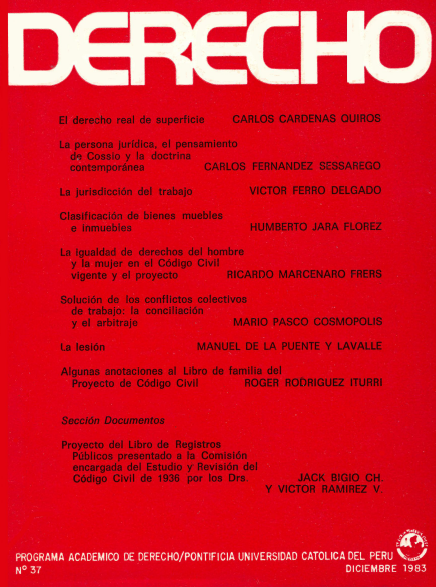
The Tort
DOI:
https://doi.org/10.18800/derechopucp.198301.007Keywords:
Tort, obligations, contract, subjective criterion, objective criterion, contractual modification, contractual termination, good faithAbstract
Comparative legislation reveals that the institution of tort has been approached differently in different legal systems. As a result, some legal systems adopt an objective approach, whereby tort is recognized when there is an obvious or notable disproportion between the parties' performance or obligations in a contract. On the other hand, other systems adopt a subjective approach, which mainly takes into account the exploitation by one of the contracting parties of the need or inexperience of the other. As far as the Peruvian legal system is concerned, it is proposed that the injury should be admitted in onerous contracts following an objective-subjective criterion. To that extent, the action for tort will be valid when the situation of disproportionality between the benefits is corroborated, but in addition, it will be necessary not only the existence of a situation of need in the injured contracting party but also the abuse or exploitation on the part of the injurer who knew of the need of the injured party. The corroboration of all these elements will allow the injured party to have access to the most favorable solution; namely, the rescission or modification of the contract.
Downloads
Downloads
Published
How to Cite
Issue
Section
License
Copyright (c) 2016 Derecho PUCP

This work is licensed under a Creative Commons Attribution 4.0 International License.
