


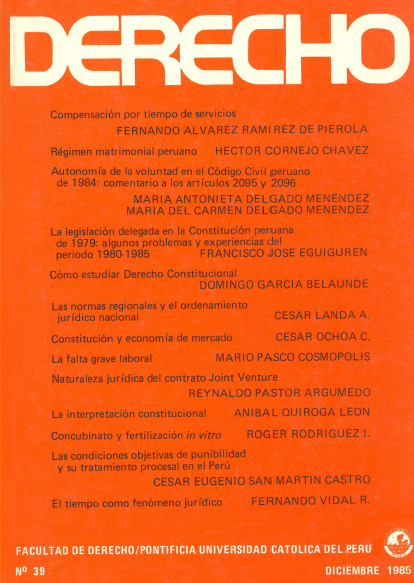
Compensation for Service Time
DOI:
https://doi.org/10.18800/derechopucp.198501.001Keywords:
compensation for time of service, severance pay, labor law, employment contract, social benefits, special regimesAbstract
This paper deals with the regulations on the Compensation -or “Indemnity”- for Time of Services (CTS), a fundamental legal institution in Peruvian labor legislation. This benefit applies in all cases of termination of the employment contract, regardless of the cause. By its nature, it constitutes a remuneration independent of the remuneration to which the employee is entitled on an annual basis for the energy expenditure experienced during such period. Along these lines, the legal provisions that must be followed to determine the amount of the CTS are explained, taking into account the employee's remuneration at the time of termination and his accumulated service time. Next, the different situations that affect the compensation are explained, and in turn, the special regimes applicable to specific sectors that have particular rules for the calculation and payment of the CTS are mentioned. Finally, the author argues that the CTS, like other social benefits, is supported by Peruvian law and is considered a fundamental right to guarantee the economic stability of workers once their employment relationship ends.
Downloads
References
Abrahamsohn, G., Murguía, A. y Alcabés, N. (1982). Sistematización de la Legislación Laboral Peruana (Tomo I). Centro Interamericano de Administración del Trabajo.
Barassi, L. (1971). Tratado de derecho del trabajo (Tomo III).
Bendezú, M. (1983). Derecho del trabajo en construcción civil. Servicio Nacional de Capacitación para la Industria de Construcción Civil (SENCICO).
Cabanellas, G. (1972). Compendio de derecho laboral. Heliasta.
Caldera, R. (1960). Derecho del Trabajo. WI Ateneo.
Deveali, M. (1953). Lineamientos de derecho del trabajo. TIP Editora Argentina.
De la Torre, C. (1983). Jurisprudencia del Trabajo (Tomo II).
Ejecutoria Suprema. (1954, 23 de julio).
Expediente N° 2789. (1947). Resolución de la Corte Suprema.
Expediente N° 1303/54. (1954, 23 de abril). Resolución de la Corte Suprema.
Expediente N° 2323-81-MEF. (1981, 08 de septiembre). Resolución del Tribunal de Trabajo.
Expediente N° 93/951. (1981, 11 de octubre). Resolución de la Corte Suprema.
Ferrero, R., Scudellari, C. y Zavala, J. (1977). Derecho del trabajo. Sesator.
Gallart, A. (1936). Derecho español del trabajo. Labor.
Krotoschin, E. (1965). Tratado práctico de derecho de trabajo. Ediciones Depalma.
Lima, A. (1936). Despedida injusta: lei 62 de 5 de junho de 1935 (estabilidade dos empregados da industria e do comercio). Genese, doutrina e commentario. A. Coelho Branco.
Mantero, E. (1984). Revista Actualidad Laboral.
Pérez, A. y Morales, P. (1976). Manual Laboral (Tomo I). Editorial Economía y Finanzas.
Ramírez, J. (1945). El contrato de trabajo. La Ley.
Ramírez, J. (1963). Codificación de la legislación del trabajo y de previsión social del Perú (2.ª ed.). Editorial Antonio Lulli.
Unsain, A. (1935). Empleados de comercio: exposición y comentario a la Ley N° 11.729 (reformando los artículos 154 a 160 del Código del Comercio). Valerio Abeledo.
Valdez, N. (1964). Legislación del empleado. Editorial Jurídica.
Downloads
Published
How to Cite
Issue
Section
License
Copyright (c) 2016 Derecho PUCP

This work is licensed under a Creative Commons Attribution 4.0 International License.
