


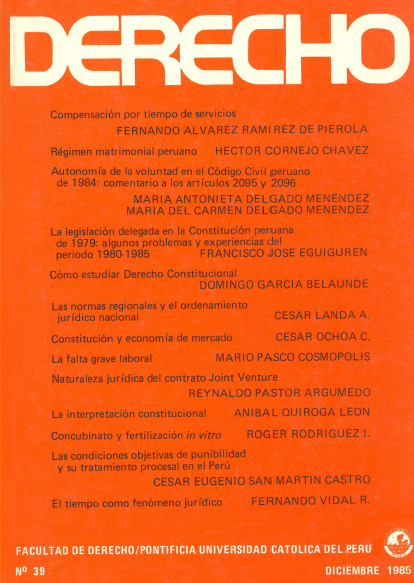
Delegated Legislation in the Peruvian Constitution of 1979: Some Problems and Experiences of the Period 1980-1985
DOI:
https://doi.org/10.18800/derechopucp.198501.004Keywords:
Constitution, delegation, legislative powers, Executive Branch, parliamentary controlAbstract
The paper analyzes how the strengthening of the Executive Branch has allowed the government to assume legislative functions that traditionally corresponded to the Legislative Branch, which has led to an increasingly active presence of the Executive in the field of normative production. In this regard, it is noted that the 1979 Constitution contemplated the delegation of legislative powers to the Executive, but the experience of the 1980s revealed deficiencies in the regulation and supervision of this delegation. The author mentions some examples in which the Executive dictated norms in matters such as organic laws, tax and criminal legislation, arguing that certain areas should be reserved only to the Parliament. Therefore, the paper proposes greater parliamentary control and the need to respect constitutional limits to avoid abuses in the use of these powers.
Downloads
References
Álvarez, E. (1983). El régimen político español. Editorial Tecnos.
Biscaretti, P. (1973). Derecho constitucional. Editorial Tecnos.
Burdeau, G. (1981). Derecho constitucional e instituciones políticas. Editorial Nacional.
Cooper, H. (1967). Diez ensayos sobre el common law.
Eguiguren, F. (1984). Normas contrarias a la Constitución y la ley. Revista del Foro, año LXXXI, (1), 87-111. Colegio de Abogados de Lima.
Garronera, A. (1980a). El lugar de la ley en la Constitución Española. Centro de Estudios Constitucionales.
Garronera, A. (1980b). Acerca de las leyes orgánicas y de su espuria naturaleza jurídica. Revista de Estudios Políticos, (13), 169-208.
Montero, J. y García, J. (1984). El control parlamentario. Editorial Tecnos.
Downloads
Published
How to Cite
Issue
Section
License
Copyright (c) 2016 Derecho PUCP

This work is licensed under a Creative Commons Attribution 4.0 International License.
