


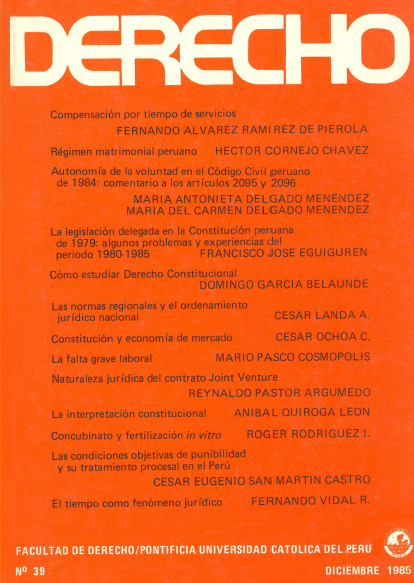
Time as a Legal Phenomenon
DOI:
https://doi.org/10.18800/derechopucp.198501.013Keywords:
Time lapse, computation rules, statute of limitations, expiration, legal term, validity of laws, modification of rights, extinction of rights, regulatory temporalityAbstract
This article focuses on time as a legal phenomenon, highlighting its inextricable link with human existence and its influence on legal relations. Based on this idea, the author argues that every legal fact is located in time, generating the creation or extinction of rights, exemplified by the statute of limitations and expiration. In addition, he addresses the notion of time in law, emphasizing that, although its essence is more of a philosophical issue, law adopts it as a natural fact, the passage of which generates legal effects. Then, it examines the distinction between natural and human facts, highlighting that time, being a physical phenomenon, is classified as a natural legal fact, influencing legal relations without the intervention of human will. Finally, the article underlines the importance of time in the determination of subjective rights, the validity of rules and its relevance in the computation of legal deadlines. In addition, the rules established by the Civil Code for the computation of time are mentioned, evidencing the need for precision in its legal application.
Downloads
References
Albaladejo, M. (1958). El Negocio Jurídico. Bosch.
García Amigo, M. (1979). Instituciones de Derecho Civil I: Parte General. Editoriales de Derecho Reunidas.
León Barandiarán, J. (1963). Comentarios al Código Civil Peruano. Ediciones del Sol.
Messineo, F. (1971). Manual de Derecho Civil y Comercial. Jurídicas Europa América.
Vidal Ramirez, F. (1985). Teoría General del Acto Jurídico. Cultural Cuzco.
Downloads
Published
How to Cite
Issue
Section
License
Copyright (c) 2016 Derecho PUCP

This work is licensed under a Creative Commons Attribution 4.0 International License.
