


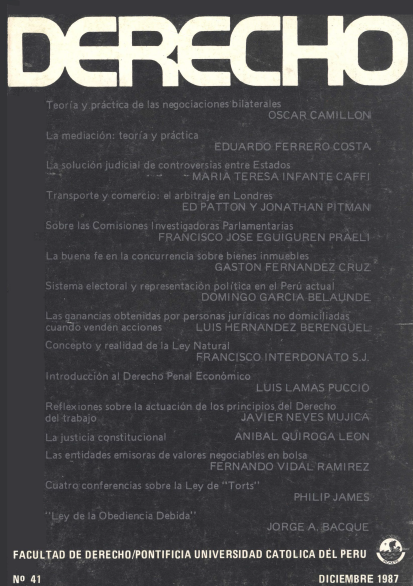
Concept and Reality of Natural Law
DOI:
https://doi.org/10.18800/derechopucp.198701.009Keywords:
Natural law, human essence, duties, positive law, rationality, rightsAbstract
The text analyzes the concept of natural law, which is based on universal principles that guide human conduct towards the “good”, independently of the provisions of positive law. The author points out that natural law is not a human creation, but a reality discovered in the very essence of the human being, which manifests itself through practical judgments that allow discerning between what is right to be done and what should be avoided. He argues that law transcends epochs and cultures, being inherent to human nature, which is reflected in norms that prohibit murder, theft or deceit. To that extent, it is emphasized that these “duties” are a requirement that emanates from the personal being. Likewise, unlike positive laws, natural law responds to immutable principles and does not depend on human codifications, but on the rationality of human beings. However, its application may vary according to historical or cultural circumstances, as occurred with slavery. In this regard, the author argues that the historical existence of slavery does not contradict the fundamental principles of this law, since this practice can be classified as a fourth-class precept within the hierarchy of natural law. In essence, this law connects the intrinsic morality of man with universal values, establishing an ethical order superior to human laws.
Downloads
References
Aubert, J. (1967). Le droit naturel: ses avatars historiques et son avenir. La vie spirituelle, (81), 282-324.
Balmes, J. (1842). El protestantismo comparado con el catolicismo. Imprenta de Antonio Brusi.
Bockle, F. (1971). El derecho natural. Editorial Herder.
Camus, A. (1951). L’Homme Revolté. Gallimard.
Congar, Y. (1969). Dos factores de sacralización en la vida social de la Edad Media. Concilium: Revista Internacional de Teología, (47), 56-70.
De Soto, D. (1922). Tratado de la justicia y el derecho. Editorial Reus.
Denzinger, H. (1959). El magisterio de la iglesia. Manuel de los símbolos, definiciones y declaraciones de la iglesia en materia de fe y costumbres. Editorial Herder.
Maritain, J. (1949). Neuf leçons sur les notions premiéres de la philosophie morale (Tomo II). Tequi.
Ovidio, P. (s/f). Metamorfosis (Libro VII). Video Meliora, proboque; deteriora sequor.
Rahner, K. (1969). Escritos de teología (Volumen VI). Taurus Ediciones.
San Agustín. (369-370). Confesiones (Libro II).
San Agustín. La ciudad de Dios (Libro XIX).
Downloads
Published
How to Cite
Issue
Section
License
Copyright (c) 2016 Derecho PUCP

This work is licensed under a Creative Commons Attribution 4.0 International License.
