


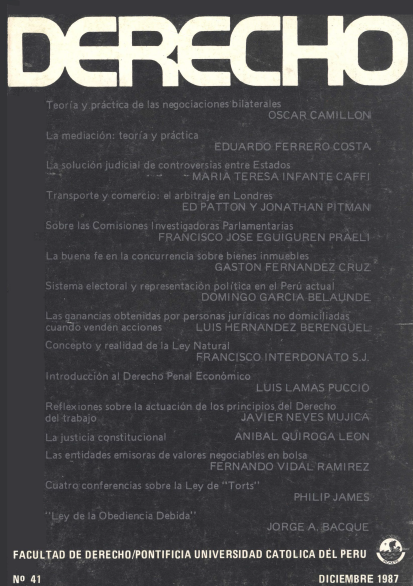
Reflexiones sobre la actuación de los principios del derecho del trabajo
DOI:
https://doi.org/10.18800/derechopucp.198701.011Palavras-chave:
Derecho del trabajo, principios, decreto de urgencia, jornada laboral, constituciónResumo
El texto examina el impacto de los principios del derecho del trabajo en contextos específicos, utilizando como caso de estudio la suspensión del horario de verano en Perú durante 1986 y 1987. Según los hechos del caso, este horario, que reducía la jornada laboral para trabajadores estatales y de la administración pública, fue restablecido a 8 horas mediante decretos de urgencia. A partir de ello, se cuestiona la validez de tales decretos debido al incumplimiento de los requisitos de necesidad urgente y extraordinaria, así como a la vulneración de los derechos adquiridos por los trabajadores. En ese contexto, el autor analiza dos posibles interpretaciones del artículo 44 de la Constitución: una de carácter progresivo, que prohíbe el retroceso en la protección de los derechos laborales, y otra que permite la ampliación de la jornada laboral dentro del límite de 8 horas. En virtud de ello, se propone una perspectiva equilibrada que garantice el respeto a los derechos adquiridos y priorice la aplicación del principio de la norma más favorable. Finalmente, se destaca que las acciones de amparo interpuestas contra estos decretos fueron exitosas, estableciendo un precedente significativo en el ámbito jurídico laboral.
Downloads
Referências
Alonso, M. (1981). Derecho del trabajo. Facultad de Derecho de la Universidad de Madrid.
Decreto Ley N° 20509. (1974, 15 de enero).
Decreto Supremo N° 006-71-TR. (1971, 29 de noviembre).
Decreto Supremo N° 004-74-TR. (1974, 30 de abril).
García, E. y Fernández, T. (1984). Curso de derecho administrativo. Editorial Civitas S.A.
Martín, A. (1978). Concurrencia y articulación de normas laborales. Revista de Política Social, (119), 5-31.
Neves, J. (1987). Normas y principios del derecho del trabajo. Themis, (6), 29-32.
Ojeda, A. (1971). La concurrencia de convenios colectivos. Revista de Política Social, (89), 33-75.
Ojeda, A. (1982). El principio de condición más beneficiosa. Revista Política Social, (134), 7-48.
Plá, A. (1978). Los principios del derecho del trabajo. Ediciones Depalma.
Predieri, A. (1984). El sistema de las fuentes del derecho. En E. García y A. Predieri (Dir.), La Constitución española de 1978: estudio sistemático. Editorial Civitas S.A.
Reglamento por Resolución Suprema N° 010-74-INAP (1974, 15 de febrero).
Resolución Suprema N° 070-74-INAP-DNP. (1971, 18 de diciembre).
Sala, T. (1977). El principio de la condición más beneficiosa. Revista de Política Social, (114), 37-66.
Santillán, S. (1984). Sentencias del Tribunal Constitucional sobre Derecho del Trabajo. Fundación Friedrich Ebert.
Sentencia N° 11/1981. (1981, 8 de abril). Recurso de inconstitucionalidad N° 192180.
Villa, L. (1970). El principio de la irrenunciabilidad de los derechos laborales. Revista de Política Social, (85), 7-71.
Villa, L. (1985). Instituciones del derecho del trabajo. Editorial Cera.
Downloads
Publicado
Como Citar
Edição
Seção
Licença
Copyright (c) 2016 Derecho PUCP

Este trabalho está licenciado sob uma licença Creative Commons Attribution 4.0 International License.
