


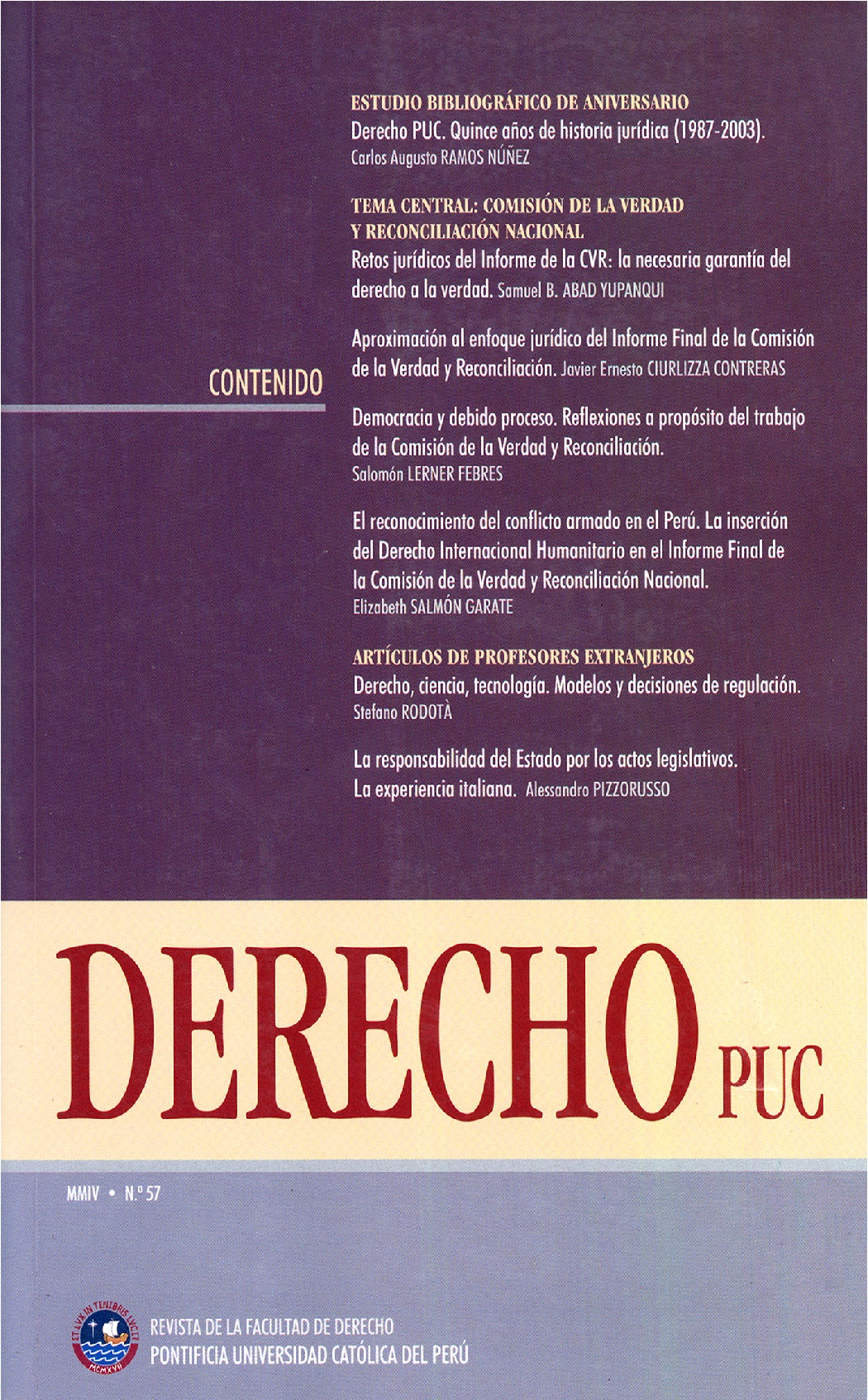
Legal Challenges of the TRC Report: The Necessary Guarantee of the Right to the Truth
DOI:
https://doi.org/10.18800/derechopucp.200401.002Keywords:
Truth and Reconciliation Commission, Right to Truth, Judicialization, Human Rights, Amnesty, Criminal Statute of Limitations, State of Emergency, Writ of Habeas Corpus, Armed ForcesAbstract
The Truth and Reconciliation Commission published its final report on 28 August 2003. This report covers a wide range of issues, but focuses particularly on the process of bringing to justice cases of human rights violations such as extrajudicial executions, forced disappearances, torture, rape, arbitrary detention, and other crimes. In this context, this paper examines the problems encountered in the process of bringing to justice cases of human rights violations that occurred in Peru between 1980 and 2000. The author points out that amnesty laws, the statute of limitations, the role of the armed forces, states of emergency and the scope of habeas corpus cannot be used as obstacles to the truth. On the contrary, they must serve as instruments that do not undermine human rights in addition to protecting constitutional assets. Despite the progress that has been made, it is essential to strengthen the judicial investigation of these crimes in order to identify and punish the perpetrators and thus overcome the sense of impunity that prevails in the country. Legal institutions must therefore facilitate this process and act as a link to truth and justice, rather than as an obstacle to progress in these cases.
Downloads
Downloads
Published
How to Cite
Issue
Section
License
Copyright (c) 2016 Derecho PUCP

This work is licensed under a Creative Commons Attribution 4.0 International License.
