


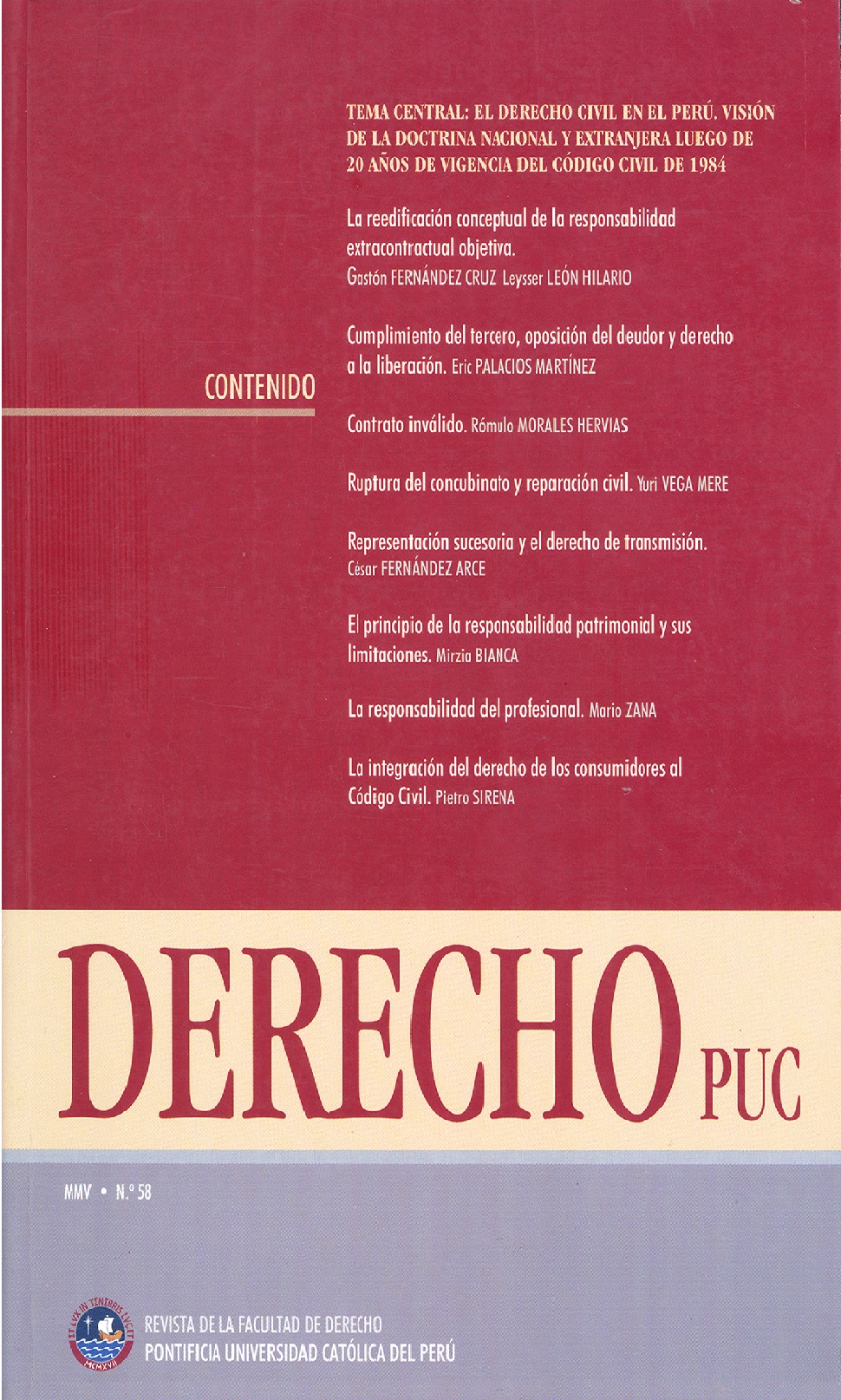
Third-Party Performance, Debtor's Opposition and Right to Discharge
DOI:
https://doi.org/10.18800/derechopucp.200501.002Keywords:
Third Party Performance, Debtor's Opposition, Creditor, Right to Discharge, Law of Obligations, Civil LawAbstract
This article analyses the legal figure of the performance of obligations by a third party and the implications that this entails in the relationship between the obligee and the obligor. In this context, it is essential to emphasise that the third party's performance may be limited by the debtor's opposition, who has the right to be personally discharged from his obligation. This right to discharge may also be subject to the consent of the obligee, who has the right to justifiably refuse the intervention of the third party in the performance of the obligation. Thus, the obligee has the power, but not the duty, to refuse performance by the third party if the obligor has expressed its opposition. Furthermore, the obligee must inform the obligor immediately if a third party offers to perform the obligation. If the obligee fails to comply with this obligation, the effectiveness of the third party's performance cannot be denied; however, such an omission may give rise to a claim for damages in favour of the obligor. To that extent, this analysis aims to clarify the limits and responsibilities of each of the parties involved, offering a theoretical framework that allows understanding the consequences of the intervention of a third party in the performance of the obligations.
Downloads
References
Andreoli, G. (1937). Contributo alla teoria dell'adempimento. Padua: Casa Editrice Dott. Antonio Milani (CEDAM).
Barassi, L. (1948). La teoría generale delle obbligazioni (T. III). Milán: Dott. A. Giuffrè Editore.
Bessone, M., y D'Angelo, A. (1988). Adempimento. En Enciclopedia giuridica Treccani (Vol. I). Roma: Istituto della Enciclopedia Italiana.
Betti, E. (1962). Interesse (teoria generale). En Novissimo Digesto Italiano (Vol. VIII). Turín: Unione Tipografico Editrice Torinese (UTET).
Bianca, M. (1990). Diritto Civile. L'obbligazione (Tomo 4). Milán: Dott. A. Giuffrè Editore.
Bigliazzi Geri, L. (1998). Interesse legittimo: diritto privato. En Rapporti giuridici e dinamiche sociali. Principi, norme, interessi emergenti. Scritti giuridici. Milán: Dott. A. Giuffrè Editore.
Breccia, H. (1991). La obligación. En G. Ludica & P. Zatti (Eds.), Trattato di Diritto Privato. Milán: Dott. A. Giuffrè Editore.
Cannata, C. A. (1984). L'adempimento delle obbligazioni. En Trattato di diritto privato diretto da Pietro Rescigno (Vol. 9, T. I). Turín: UTET.
Carboni, M. (1912). Della obbligazione nel diritto odierno. Concetto e contenuto. Turín: Edizioni Bocea.
De Cupis, A. (1970). El daño. Teoría general de la responsabilidad civil (Martínez Carrión, A. Trad.) Bosch.
Di Majo, A. (1967). La esecuzione del contratto. Milán: Dott. A. Giuffrè Editore.
Di Majo, A. (1994). Dell'adempimento in generale. Libro Quarto. Delle obbligazioni (artt. 1177-1200). En F. Galgano (Ed.), Commentario al Codice Civile Scialoja e Branca. Bolonia, Roma: Zanichelli Editore - Società Editrice del Foro Italiano.
Díez-Picazo, L. (1993). Fundamentos del Derecho civil patrimonial. Vol. II: Las relaciones obligatorias. Tecnos.
Díez-Picazo, L., y Gullón, A. (1986). Sistema de Derecho Civil (2da ed.). Tecnos.
Franceschetti, P. (1996). Obbligazioni e responsabilità civile. Verona: Edizioni Simone.
Giorgianni, M. (1975). L'inadempimento (3ª ed.). Milán: Dott. A. Giuffrè Editore.
Inzitari, B. (2004). Le obbligazioni: fonti e disciplina generale. En M. Bessone (Ed.), Istituzioni di Diritto Privato (11ª ed.). Turín: G. Giappichelli Editore.
Larenz, K. Derecho de Obligaciones (Traducción de Jaime Santos Briz, T. I). Madrid: Editorial Revista de Derecho Privado.
Messinetti, D. (1979). Oggetto dei diritti. En Enciclopedia del Diritto (Vol. XXIX). Milán: Dott. A. Giuffrè Editore.
Miccio, R. (1982). Delle obbligazioni in generale (artt. 1173-1320). En Commentario del Codice Civile (3ª ed., Libro IV, T. I, Título 1). Turín: UTET.
Moscati, E. (1999). Indebito soggettivo e attuazione del rapporto obbligatorio. En Fonti legali e fonti «private» delle obbligazioni. Padua: CEDAM.
Natoli, U. (1974). L'attuazione del rapporto obbligatorio. En Trattato di Diritto Civile e Commerciale (Vol. XVI, T. I). Fondato dai professori Antonio Cicu e Francesco Messineo, continuato da Luigi Mengoni, e ora diretto da Piero Schlesinger. Milán: Dott. A. Giuffrè Editore.
Natoli, U. (1978). Adempimento, atto dovuto, negozio giuridico. En Scritti in onore di Salvatore Pugliatti (Vol. 1, Tomo II). Milán: Dott. A. Giuffrè Editore.
Natoli, U. (1978). Adempimento, atto dovuto, negozio giuridico. En Scritti in onore di Salvatore Pugliatti (Vol. 1, T. II). Milán: Pubblicazioni dell'Istituto di scienze giuridiche, economiche, politiche e sociali della Università di Messina, Dott. A. Giuffrè Editore.
Nicolò, R. (1936). L'adempimento dell'obbligo altrui. Milán: Dott. A. Giuffrè Editore.
Nicoló, R. (1958). Adempimento. En Enciclopedia del Diritto (Vol. I). Milán: Dott. A. Giuffrè Editore.
Palacios Martínez, E., y Núñez Sáenz, Y. (2004). Teoría general de las obligaciones (1ª ed.). Prólogo de Gastón Fernández Cruz. Jurista Editores.
Trabucchi, A. (2004). Istituzioni di Diritto Civile (41ª ed., editado por Giuseppe Trabucchi). Padua: CEDAM.
Turco, C. (2002). L'adempimento del terzo. En Il Codice Civile. Commentario fondato da Piero Schlesinger e diretto da Francesco Donato Busnelli. Milán: Dott. A. Giuffrè Editore.
Downloads
Published
How to Cite
Issue
Section
License
Copyright (c) 2016 Derecho PUCP

This work is licensed under a Creative Commons Attribution 4.0 International License.
