


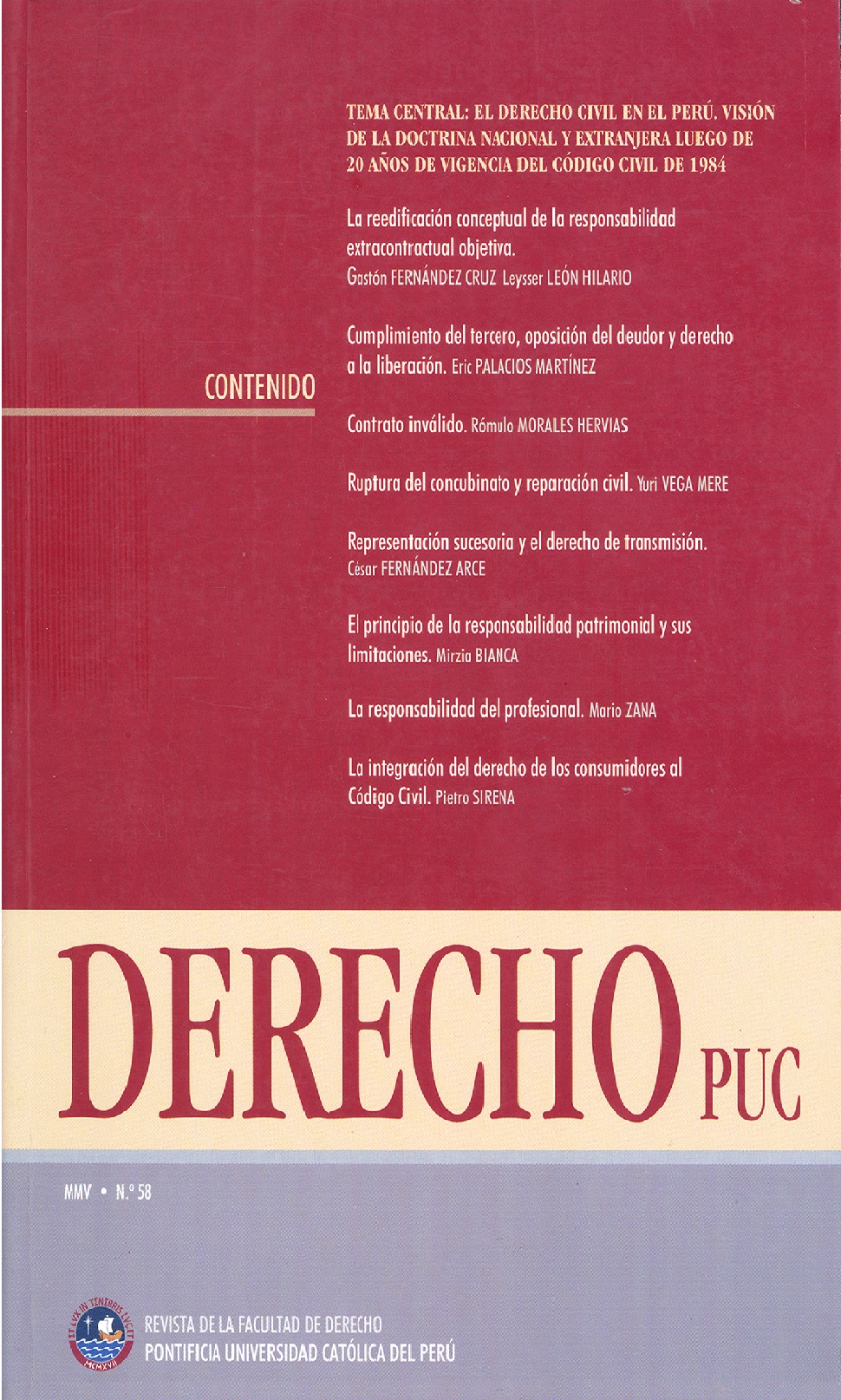
The Principle of Patrimonial Liability and Its Limitations
DOI:
https://doi.org/10.18800/derechopucp.200501.006Keywords:
Patrimonial Liability, Patrimonial Guarantee, Limitation, Debtor, Civil Law, Private Autonomy, Italian LawAbstract
Patrimonial liability refers to the duty of a person to respond with his or her assets in the event of a breach of an obligation. As the author points out, this principle has been explained by two theories. The first is the French theory of the personalisation of property, according to which property is an extension of a person's personality. The second is the German theory of 'assets for a purpose', which proposes that assets are defined not by a subject but by the purpose for which they are intended. In fact, both theories promote the principle of the indivisibility of property and therefore reject any limitation of property liability. However, the basis of this principle has evolved over time. Today, financial liability is based on an economic principle that seeks to achieve the values of profit and efficiency. Notwithstanding the above, the Italian Civil Code provides that limitations on property liability can only be established by law and not by private decisions. Although there is an ongoing debate to allow for greater flexibility through legislation, the principle of asset liability remains one that does not allow for exceptions.
Downloads
References
Aubry, G., y Rau, G. (1839). Cours de droit civil français (1a ed.). Estrasburgo.
Aubry, G., y Rau, G. (1850). Cours de droit civil français (2a ed.). Estrasburgo.
Bernardini, M. (1993). Sostituzione fedecommissaria. Rivista del notariato.
Bianca, C. (1993). Diritto civile: Vol. 4. L’ obbligazione. Milano: Giuffrè.
Bianca, C. M. (1994). Diritto civile, 5, La responsabilità. Milano: Giuffrè.
Bianca, M. (1996). Vincoli di destinazione e patrimoni separati. Padova.
Bianca, M. (2002). La fiducia attributiva. Giappichelli.
Bianca, M. (2004). Dei patrimoni destinati ad uno specifico affare (artt. 2447 bis - 2447 decies). En G. Cian y A. Trabucchi (Eds.), Commentario breve al codice civile (7ª ed.). Padua: CEDAM.
Bianchi, F. S. (1895). Corso di diritto civile italiano (Vol. IX, Parte I). Turín.
Bonilini, G. (1995). Il testamento. Lineamenti. Padova: CEDAM.
Carraro, L., Oppo, G., & Trabucchi, A. (Eds.). (1977). Commentario alla riforma del diritto di famiglia. Padova: CEDAM.
Courir, E. (1997). Limiti alla responsabilità imprenditoriale e rischi dei terzi. Milán.
Coviello, N. (1929). Manuale di diritto civile italiano: Parte generale (4a ed., Vol. I). Milán.
Crome, C. (1905). System des Deutschen bürgerlichen Rechts (T. III). Tübingen.
Falzea, A. (2003). Introduzione e considerazione conclusive. En B. Libonati y P. Ferro-Luzzi (Eds.), Destinazione di beni allo scopo. Strumenti attuali e tecniche normative. Actas de la Jornada de Estudio organizada por el Consiglio Nazionale del Notariato, Roma, Palazzo Santacroce, 19 de julio de 2003, publicadas en Quaderni romani di diritto commerciale. Milano.
Fedele, P. (1937-1939). Patrimonio. En Dizionario pratico di diritto privato (Vol. V). Milán.
Fernández Cruz, G. (1994). La obligación: apuntes para una dogmática jurídica del concepto. Themis. Revista de Derecho, (27-28), 41-56. https://revistas.pucp.edu.pe/index.php/themis/article/view/11119
Galgano, F. (1992). Diritto privato. Padova: CEDAM.
Gambaro, A. (1995). Il diritto di proprietà. En A. Cicu, & F. Messineo (Eds.), Trattato di diritto civile e commerciale (Vol. VIII, T.II). Milán.
Hansmann, H., & Kraakman, R. (2000). The Essential Role of Organization Law. Yale Law Journal, 110(3), 387-440. https://www.yalelawjournal.org/article/the-essential-role-of-organizational-law
Iudica, G. (1994). Fondazioni, fedecommesserie, trusts e trasmissione dela ricchezza familiare. En Scritti in onore di Rodolfo Sacco (T. II). Milano.
Larenz, K. (1979). Lehrbuch des Schuldrechts. (12ª ed.). Múnich.
León, L. L. (2004). La responsabilidad extracontractual (Apuntes para una introducción al estudio del modelo jurídico peruano). En La responsabilidad civil - Líneas fundamentales y nuevas perspectivas. Editora Normas Legales.
Ondo, S. (2004). Patrimoni destinati ad uno specifico affare. En Studi e materiali. Consiglio Nazionale del Notariato.
Putti, P. (1990). La sostituzione fedecommissaria prima e dopo la riforma del diritto di famiglia. En La Nuova Giurisprudenza Civile Commentata, 2(6), 421-447.
Ricca, L. (1968). Fedecommesso (diritto civile). En Enciclopedia del diritto (Vol. XVII, pp. 114-142). Milano.
Spada, P. (2002). Persona giuridica e articolazioni del patrimonio: Spunti legislativi recenti per un antico dibattito. Rivista di diritto civile, 48(6), 837-850.
Terzi, M. (1994). Sostituzione semplice e sostituzione fedecommissaria. En Successioni e donazioni (Vol. I). Padova.
Tucci, G. (2000). Consorso dei creditori, cause di prelazione e revocatoria fallimentare. En Diritto fallimentare.
Zachariae, C. S. (1917). Cours de droit civil français d'après l'ouvrage de C. S. Zachariae (5a ed.). París. (Edición original publicada en 1857-1858).
Zoppini, A. (2002). Autonomia e separazione del patrimonio, nella prospettiva dei patrimoni separati della società per azioni. Rivista di diritto civile, 48(4), 545-576.
Downloads
Published
How to Cite
Issue
Section
License
Copyright (c) 2016 Derecho PUCP

This work is licensed under a Creative Commons Attribution 4.0 International License.
