


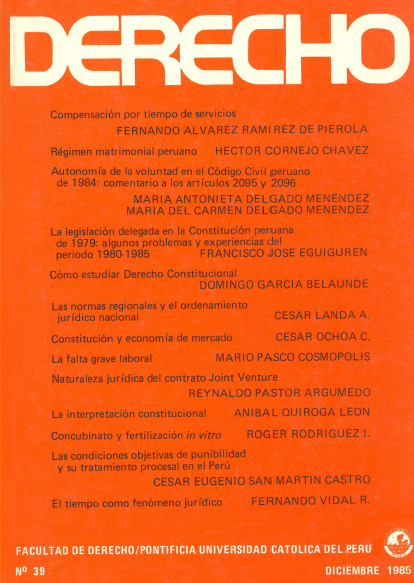
Legal Nature of the Joint Venture Contract
DOI:
https://doi.org/10.18800/derechopucp.198501.009Keywords:
Joint venture, associative contract, affectio societatis, plurality of subjects, profit motive, sui generis contract, joint venture management, grounds for dissolutionAbstract
This article analyzes the legal nature of the Joint Venture contract, highlighting its essential elements and characteristics. The Joint Venture is defined as an associative contract by which two or more persons associate to exploit a common business for a determined period of time, sharing profits and losses in a joint and unlimited manner. In addition, the elements that characterize it are addressed: the plurality of subjects, the affectio societatis, the profit motive, the participation in the losses and the personal nature of the associates. It is also emphasized that the contract has a plurilateral, commutative and successive tract nature, which leads to consider it as a sui generis contract. The author also discusses the administration, pointing out that all the partners participate in the control of the business, although there is the possibility of delegating the functions. Finally, the causes for dissolution of this contract are discussed, which include the end of the agreed term, the termination of the operation of the business, the death or incapacity of an associate, bankruptcy and the unlawfulness of the business.
Downloads
References
Pastor Argumedo, R. (1982). El Joint Venture y la Asociación en Participación. [Tesis]. Pontificia Universidad Católica del Perú.
Downloads
Published
How to Cite
Issue
Section
License
Copyright (c) 2016 Derecho PUCP

This work is licensed under a Creative Commons Attribution 4.0 International License.
