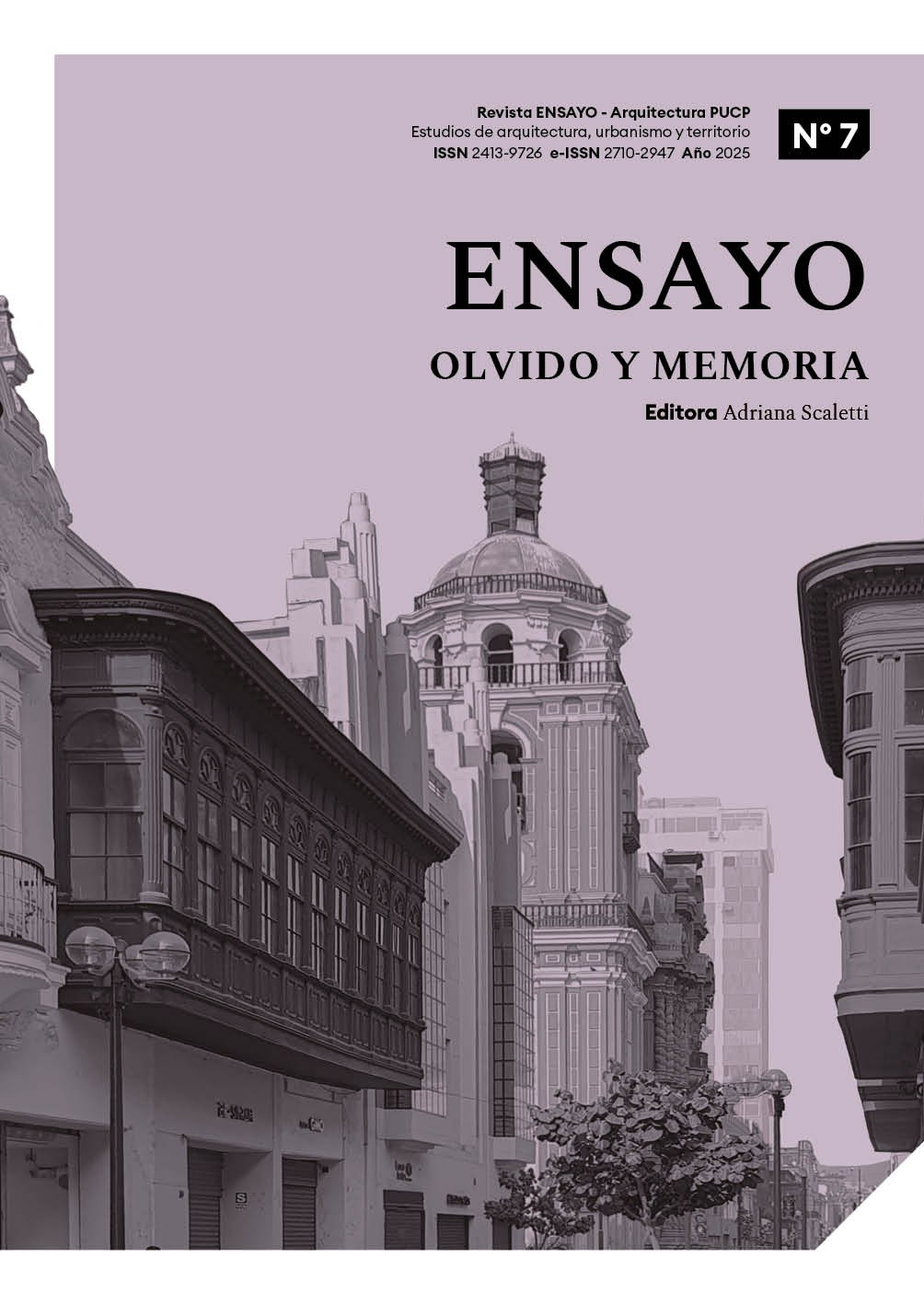
The High-Rise Building of Lima: A Heritage Under Construction (1937-1969)
DOI:
https://doi.org/10.18800/ensayo.202507.006Keywords:
Plan Piloto de Lima, Fernando Belaunde Terry, Town Planning Associates, Oficina Nacional de Planeamiento y Urbanismo, Multi-storey buildings, Cultural migrationsAbstract
This paper examines both the origin (memory) and current state (oblivion) of high-rise buildings in the Historic Center of Lima, which, built between 1937 and 1969, were innovative from functional and construction perspectives. Their development was largely driven by the need for reconstruction following the 1940 earthquake and was shaped by the urban regulations enacted in 1946.
Cultural and professional exchanges, encouraged by U.S. foreign policy, facilitated connections between European architects who had emigrated and Peruvian professionals, significantly contributing to the city’s densification. European designers played a pivotal role in the introduction of these modern structures, with notable examples including the Arnodi Building (1950) by German architect Paul Linder, the Peruvian Swiss Insurance Company Building (1952–1956) by Swiss Theodor Cron, and the Savoy Hotel (1954–1957) by Italian Mario Bianco.
Although initially celebrated, many of these buildings have since been abandoned, remodeled, or demolished due to the absence of state protection. This study highlights the economic, political, and cultural factors that support the argument for preserving these structures as part of Lima’s architectural heritage.
Downloads