
Algunas perspectivas político-ecológicas sobre la loza andina
DOI:
https://doi.org/10.18800/boletindearqueologiapucp.201601.003Keywords:
political ecology, majolica, Muslims, clusters, innovationAbstract
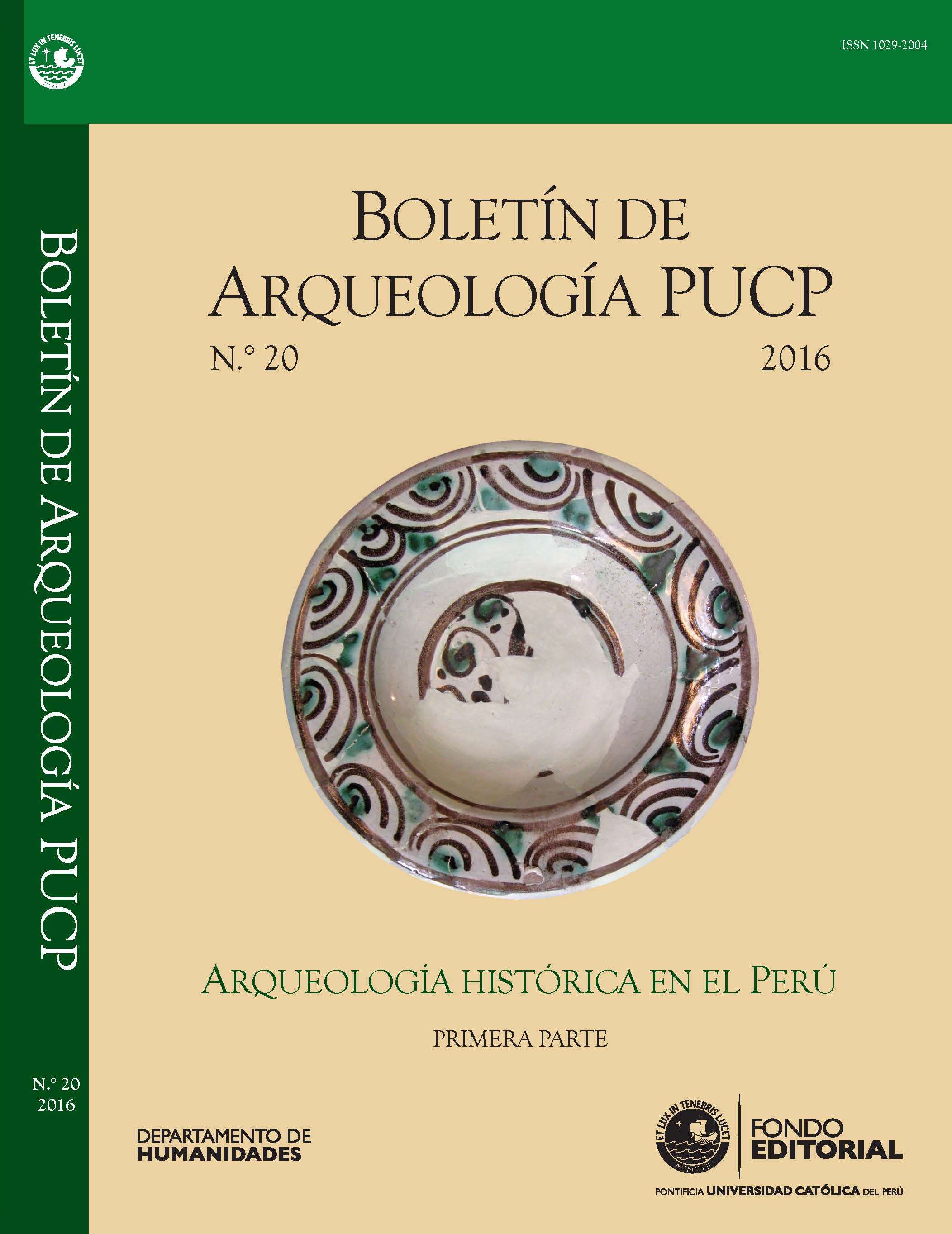
The new, hybrid scholarly field of political ecology, focused on the twenty-first century’s innovation-driven economy, has perspectives useful in studying an earlier “global” or “knowledge” economy that emerged in Spain’s sixteenth century colonial enterprise. This essay explores the production of tin-enameled pottery (majolica; loza) in Spain and its colonies, particularly the viceroyalty of Peru, through the field’s dual emphasis on the political (the ethno-religious persecution of Muslims, and the mercantilist trade policies of Christian Spain) and the ecological (resource availability and use).
Political-ecological concepts such as “business clusters,” “gatekeepers,” and “pipelines” can be applied to the many factors influencing the history of development of this ware in Spain and Ibero-America. In contrast to today’s economy, attitudes toward innovation in pottery were rather ambivalent, and innovations were primarily introduced from outside Spain (especially from Italy) rather than internally developed. Early tin-enameled ware produced in the Andes follows traditional Hispano-Moresque green and black decoration, unlike in Mexico, where it was relegated to second-class status. Blue painting arrived late, but it is not known if this was because the potters who settled in the Andes were primarily morisco refugees or a consequence of lack of access to cobalt igment because of the region’s distance from Spain.
Downloads
Downloads
Published
How to Cite
Issue
Section
License
Copyright (c) 2017 Boletín de Arqueología PUCP

This work is licensed under a Creative Commons Attribution 4.0 International License.