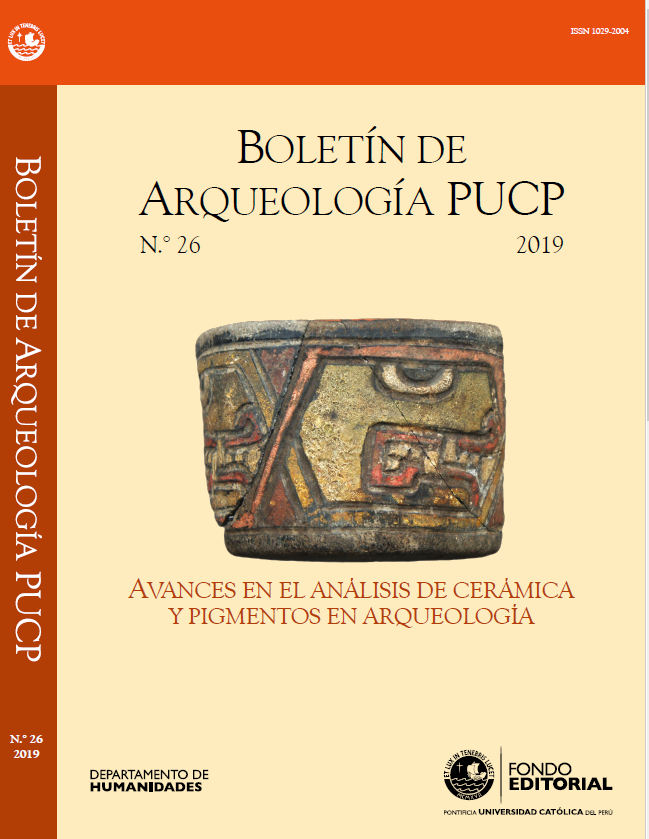
THE PIGMENTS USED IN EARLY PARACAS POTTERY POST FIRED PAINTS FROM PUERTO NUEVO AND THE EXCHANGE NETWORKS OF THE SOUTHCENTRAL COAST AND HIGHLANDS OF PERU BETWEEN THE IXth AND VIth CENTURIES BC
DOI:
https://doi.org/10.18800/boletindearqueologiapucp.201901.004Keywords:
Formative, Early Horizon, South Coast, Peru, Early Paracas, post-fired painting, pigments, XRF, RAMAN, XRD, economics, exchangeAbstract
We present the results of the chemical and mineralogical composition analysis, by means of XRF, RAMAN and DRX, of the post-fired paint used to decorate Early Paracas ceramic vessels from the Puerto Nuevo site, on the south-central coast of Peru. The characterization of these pigments allows us to approach the mechanisms used by the inhabitants of the Pisco valley from the 9th to the 6th centuries BC to obtain these raw materials. We speculate about the existence of a combination of strategies that include direct access to obtain hematite and antlerite available from nearby sources, and horizontal coast-coast exchange, as well as vertical coast-sierra exchange, using llama caravans, to procure respectively anatase, in the first case, and cinnabar, realgar, orpiment and pararealgar, in the other, from more distant sources.
Downloads